Read the Milk Label: A Raw Milk Warning, Smarter Food Shopping & Garden Tips — Daily Farm Brief
Read the Milk Label Before You Pour
A practical food warning, smarter shopping, an organic garden check and a backyard pantry
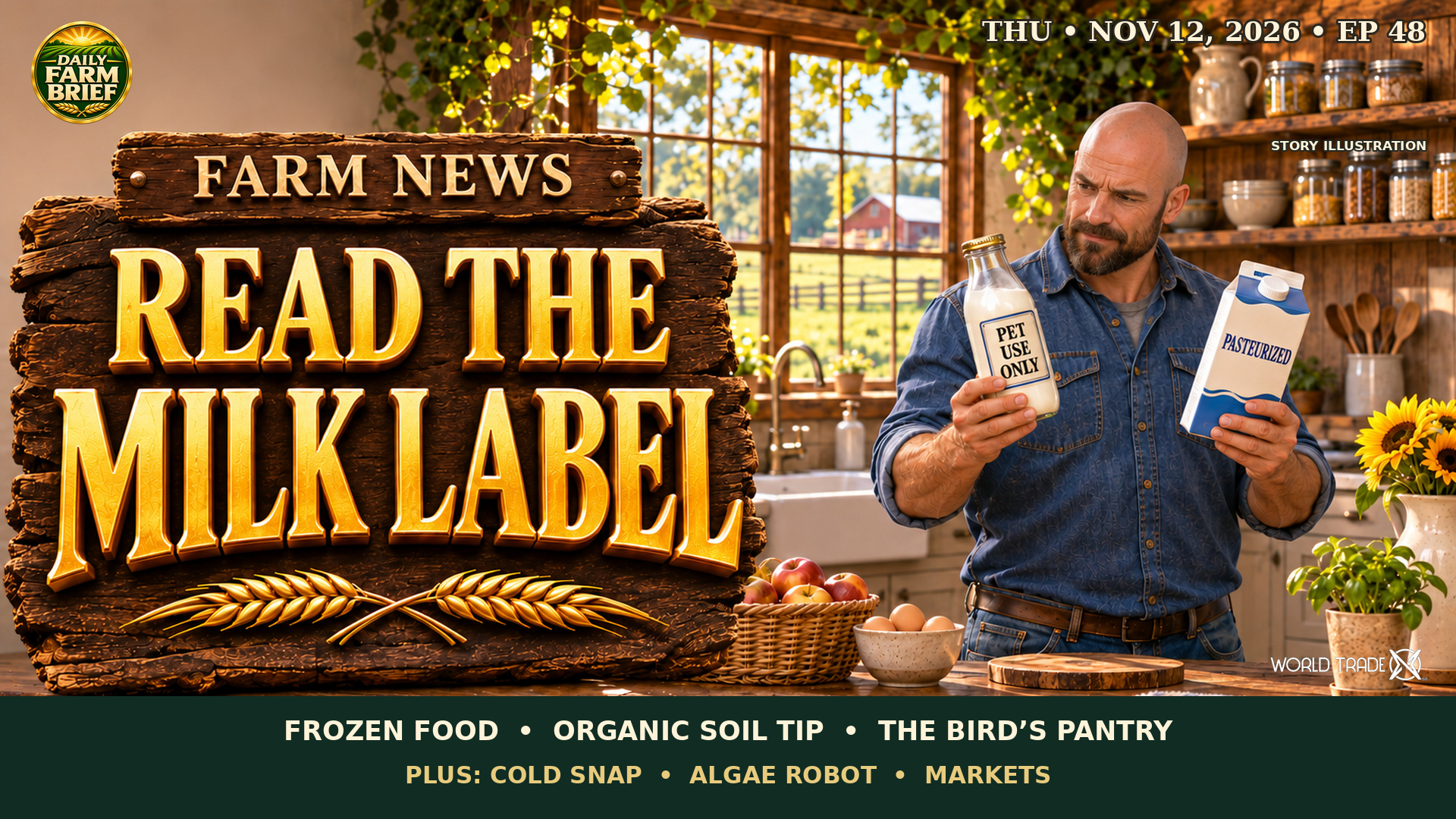
A milk bottle can look reassuring long before you read a word on it. A farm name, a familiar face at the stand, and a glass container may all suggest care. But the decision that matters at home starts with the label. Is this product intended for people? And has it been pasteurized?
Those questions lead Episode 48 of Daily Farm Brief. We also look at vegetables that earn their place in the freezer, a garden amendment you may not need, and a small bird that prepares for tomorrow by hiding today’s groceries. There is a useful thread through the show: a little attention before acting can make an ordinary daily decision better.
What Delaware actually announced. In a November 10, 2026 notice, Delaware’s Department of Agriculture said that facilities selling raw milk for human consumption must hold a valid permit under its Raw Milk Program. At the time of that notice, the department said it had not issued those permits. Some raw milk available in the state was labeled for pets. The producers had completed pet-food registrations, but were not permitted or inspected under the Raw Milk Program. [1]
The distinction is specific. A pet-food registration does not establish permission to sell the same milk for people. The notice also said pet-labeled products had not undergone the pathogen testing described for the raw-milk program. This was a state warning about labeling, oversight and risk; it should not be presented as proof that every bottle contained a particular germ. Nor should a dated Delaware permitting statement be treated as the rule everywhere. [1]
Pasteurization answers a separate question. Even a legal raw-milk sale does not make raw milk risk-free. Pasteurization uses a controlled heating process to kill disease-causing germs. CDC says careful farming practices can reduce contamination but cannot guarantee the safety of raw milk. Its guidance favors pasteurized milk and dairy products, which provide milk’s nutritional benefits without the risks associated with consuming it raw. [2]
That matters especially for households with older adults, young children, pregnant family members or people with weakened immune systems. CDC identifies these groups as more vulnerable to serious illness from germs found in raw milk. Milk can carry organisms such as E. coli, Salmonella, Listeria and Campylobacter. A wholesome appearance is not a laboratory result. [2]
The useful habit: turn the container around before it goes in the cart. Read the intended use and look for pasteurization. If the wording is unclear, ask. Keep milk labeled for pets out of the family’s drinking glasses. A quick question at the point of purchase is easier than trying to settle it after everyone has had breakfast.
Sources: 1. Delaware Department of Agriculture, November 10 notice · 2. CDC: Raw Milk
Give Frozen Food a Little Credit
The better purchase is the one that works in your kitchen
Fresh produce deserves its good reputation. But a practical food budget needs more than one aisle. A bag of frozen vegetables or a can from the pantry can help turn “there is nothing to eat” into a straightforward supper. Choosing them is not an admission that you have given up on nutritious food.
Colorado State University Extension notes that frozen and canned fruits and vegetables can be nutritious alternatives to fresh. Produce destined for those forms is commonly harvested when ripe and processed soon afterward. The result can be a convenient supply that lasts longer at home. That does not mean every product has the same ingredients, texture or price. It means the package deserves a fair reading. [3]
Compare the contents, not just the pictures. Plain frozen vegetables leave the seasoning in your hands. A prepared vegetable side may bring a sauce and a different sodium level with it. For canned vegetables, compare the Nutrition Facts panels and consider reduced-sodium or no-salt-added choices. Fruit packed in water or its own juice offers an alternative to fruit in syrup. [3]
The FDA’s sodium guidance makes the comparison more useful: check the serving size as well as the sodium number. Its general label guide treats 5 percent of the Daily Value or less per serving as low and 20 percent or more as high. A container with several servings can contribute much more than a quick glance at one serving suggests. [4]
Here is an example, not a claim about a particular brand. Suppose one package lists 200 milligrams of sodium for half a cup and another lists 300 milligrams for a full cup. Comparing only 200 with 300 gives the wrong impression. At the same one-cup portion, the first would provide 400 milligrams. Equal portions make a fair comparison.
Give the food a job before buying it. One household may use a small amount of frozen peas at a time. Another may finish a can of vegetables with dinner. Someone cooking for one may value a resealable bag; a household with little freezer space may value the shelf space a can uses. There is no need to choose a single format for every meal.
Texture also belongs in the decision. CSU Extension points out that preserved produce may not have the crunch of fresh. Use that difference: choose fresh when crispness is the point and consider frozen or canned ingredients for a cooked dish. Inspect packaging too; damaged cans or a heavy buildup of ice crystals deserve attention. [3]
An easy experiment for this week is to plan one meal around something already in the freezer or pantry before buying more. Count the usable portions and compare the cost of what your household will actually eat. A bargain that spoils untouched never made it onto anyone’s plate. Fresh is wonderful; practical is wonderful too.
Sources: 3. Colorado State University Extension: Using Canned and Frozen Fruits and Vegetables · 4. FDA: Sodium in Your Diet
Is Your Garden Really Hungry?
An organic gardening tip that begins with information
A bare garden bed can make another bag of compost feel like an obvious improvement. Working something into the soil feels productive, and organic material sounds harmless. Yet the useful question is not simply whether an amendment is organic. It is whether this bed needs what the amendment supplies.
University of Minnesota Extension explains that repeated heavy compost or manure applications can create nutrient imbalances. Some heavily amended soils also develop high soluble-salt levels or excessive alkalinity. A plant can even show deficiency symptoms when the soil already contains too much of something else, because one excess can interfere with the uptake of another nutrient. [5]
Compost is useful; the amount still matters. The lesson is not to stop using it everywhere. It is to stop treating every bed, every season and every previous application as if they were identical. A bed that has received years of manure-based compost begins this spring with a different history from a new garden in an old lawn.
A soil test turns that history into something more useful than a guess. Minnesota Extension describes a standard lawn-and-garden test that reports information such as pH, organic matter, phosphorus and potassium, with recommendations. It suggests testing every three to five years and when making a major change, such as converting lawn to garden. Your local laboratory can advise on the right test and timing for your situation. [6]
Ask the laboratory before collecting the sample. Follow its directions for sampling depth, clean equipment, how to combine samples and what to submit. Explain what you plan to grow and flag an unusual history, such as repeated heavy compost additions or suspected salt problems. Do not assume every basic test measures every possible issue. [5, 6]
Lime deserves the same pause before purchase. It raises soil pH. That may help a soil that is too acidic for the intended crop, but it is not a universal spring tonic. Minnesota’s guidance notes that crop needs differ and uses blueberries as an example of plants preferring acidic conditions. An amendment that suits one crop can be the wrong move for another. [5]
Make a simple garden record. Write down the bed, the test date, the crop you intend to grow and what you actually applied. Keep the report with those notes. The next time you consider an amendment, you will have your own garden’s history in front of you, rather than a memory of what you think you added.
This is a satisfying kind of gardening thrift: spending effort on the question before spending money on the answer. The right result may be a specific addition. It may also be leaving a well-supplied bed alone. A productive garden is the goal; an empty stack of amendment bags is not a measure of success.
Sources: 5. University of Minnesota Extension: Too Much Compost and Manure · 6. University of Minnesota Extension: Soil Testing for Lawns and Gardens
A Small Bird With Tomorrow in Mind
The Old Farmer’s Almanac—and a tiny laboratory surprise
A chickadee lands, takes a seed and leaves. A moment later it is back. At first glance, that may look like a bird with a remarkable appetite. Watch where it goes, though, and you may be seeing a food-storage routine rather than another lunch.
The Old Farmer’s Almanac describes black-capped chickadees carrying food away to tuck into tree crevices for later. Sunflower seeds and suet are among the foods that attract them in winter. The same guide points out the familiar chickadee call and the clear, two-note whistle that can help listeners recognize a bird they have been hearing all along. [7]
Those trips can be tiny grocery runs. Cornell’s bird educators explain that chickadees hide seeds in places such as bark, then rely on their capacity to remember locations to recover their supplies. The bird is working with a scattered pantry, not one central cupboard. What looks like an ordinary dash between branches has a useful purpose when food is harder to find. [8]
Stored food is only one part of getting through cold weather. Cornell also describes chickadees sheltering in cavities, fluffing their feathers for insulation and lowering their body temperature under controlled conditions to save energy. These are adaptations to a demanding season, not evidence that cold weather is easy for a small animal. [8]
The reward for us is simpler. Take a minute at the window, put down the phone and follow a single trip. Does the bird stop at a branch? Move behind bark? Return by the same route? You do not need a special expedition to find something interesting outdoors. Sometimes the whole story begins at the feeder.
As Rick says in the show, it is possible to forget why you walked into the kitchen while a little bird remembers which tree has breakfast. That is a good reason to smile—and a good reminder that familiar wildlife still has surprises left.
Just the essentials: living algae help move a gripper. The other small-scale surprise in the opening headlines comes from Delft University of Technology. Researchers developed a soft, roughly two-centimeter actuator combining hydrogel layers and microalgae. Light changes the algae’s activity, affecting acidity and causing the layers to swell differently. The strip bends. Laboratory demonstrations included manipulating a rubber ring and a small metal ball. [9]
The qualification matters as much as the novelty. This is experimental research, announced October 22, not a harvesting robot for sale or a new machine already working on farms. Demonstration footage was substantially sped up. Its interest lies in the idea that living material can help turn an environmental signal into motion. Future practical uses will need further development and testing. [9]
Sources: 7. The Old Farmer’s Almanac: Black-Capped Chickadee · 8. Cornell Lab: How Do Song Birds Survive Winter? · 9. TU Delft: Soft Robot Arm Powered by Algae
The Market Close—and the Weather Ahead
Dated numbers for a Thursday morning show
Wednesday’s grain finish was mixed. December corn slipped one cent to $4.48 a bushel. January soybeans gained 2¾ cents to $12.3075, and December Chicago wheat rose 6¾ cents to $5.995. Pro Farmer’s closing report pointed to dollar strength limiting corn buying, with renewed buying and short covering helping the soybean complex and wheat. These are November 11 closes, replacing the earlier morning snapshot. [10, 11]
Read the contract as carefully as the price. December corn and January soybeans refer to different delivery months. Prices on a futures board are not a promise of the cash bid at a local elevator. The ticker keeps units visible because dollars per bushel, dollars per hundredweight and cents per pound cannot be compared as if they were the same measurement.
| Market / contract | Nov 11 close or settlement | Daily change |
|---|---|---|
| Corn / December 2026 | $4.48 per bushel | Down 1¢ |
| Soybeans / January 2027 | $12.3075 per bushel | Up 2¾¢ |
| Chicago wheat / December 2026 | $5.995 per bushel | Up 6¾¢ |
| Live cattle / December 2026 | $218.975 per cwt | Down $0.225 |
| Feeder cattle / January 2027 | $327.80 per cwt | Up $1.125 |
| Lean hogs / December 2026 | $56.025 per cwt | Up $0.225 |
| Class III milk / November 2026 | $17.82 per cwt | Up 2¢ |
| Class IV milk / November 2026 | $21.04 per cwt | Up 2¢ |
The dairy cash market had its own mixed finish: cheddar blocks were $1.6800 a pound, barrels $1.6850, butter $1.2575, dry whey $0.8700 and Grade A nonfat dry milk $2.0725. Blocks and whey rose; the other three fell. These are November 11 final cash-market figures, not milk-futures prices. [12]
Energy and pump prices use separate clocks. December WTI crude was $86.37 a barrel, up 33 cents, in the delayed November 11 snapshot at 2:09 p.m. Central; that is not a closing settlement. EIA’s latest weekly U.S. survey, dated November 9, showed regular gasoline at $3.995 a gallon and on-highway diesel at $6.127, including taxes. Weekly declines were 15.8 and 16.5 cents respectively. [13, 14]
Cold air is the other practical headline. The National Weather Service’s November 11 outlook described colder air and gusty winds spreading across the central and eastern United States, with a freeze threat extending into the South by the weekend. The West had a different pattern: warmth in many areas, with a Pacific Northwest storm approaching. These are regional outlooks; use a local forecast for decisions about your own crops, animals or travel. [15]
Thursday’s moon phase is waxing crescent. The video’s ticker runs through agricultural markets and fuel, then headlines, regional weather and the moon before starting again. The show stays conversational while those extra details remain available to viewers. Find Daily Farm Brief and the matching daily blog at dailyfarmbrief.com. [16]
Sources: 10. Pro Farmer: November 11 After the Bell · 11. Farms.com: Futures Quotes · 12. Daily Dairy Report · 13. Farmbucks: December WTI · 14. EIA: Gasoline and Diesel Fuel Update · 15. National Weather Service: November 11 Short Range Discussion · 16. TheSkyLive: Moon, November 12, 2026

Rick is a broadcaster at heart, having built an internet radio network back in 1993. Back then they were called archived shows (mp3), the term podcast didn't exist but some people were already podcasting and he was one of them. Internet radio fizzled out fast when the Sirius satellites were launched and all the big networks inhaled all the programming. Here we are 30 years later. My how things have changed. Independent media put regular people on the same playing field and news and entertainment changed forever. His passion is being a boat captain and spending every minute with his little girl dog Mandy by his side.
His news delivery style is described as "Hit the fact, explain why anyone would care, make a joke and move on". He tears though things he believes will be worth a listener knowing and hoping he can get them to smile or chuckle. Much of the news is not "Happy news" and he realizes how hard things are for farmers and truckers, so he tries to keep it light and comical because no matter how bad things get we always need to find a way to laugh about it or we'd all go crazy.
If you want a passionate ally to dole out the news while mixing it up with funny short stories and odd side news, you will find his favorite program "Daily Farm Brief" a worthy 10 minutes of you weekday.
Preventing Irrigation Copper Theft: A Guide to Farm Security Tech