Check Your Freezer! Hidden Allergens, Salad Surprise & Garden Tips — Daily Farm Brief
Check Your Freezer: Hidden Allergens, a Salad Surprise, and Smarter Ways to Grow
Daily Farm Brief • Wednesday, November 11, 2026 • Episode 47
By Rick Portanova
You buy a beef snack. You check the label. Nothing tells you there is fish inside. But an ingredient in the sauce contains anchovy.
That is the problem at the center of today’s lead story, and it is a good reason to take a second look at what is sitting in the freezer. For a family managing food allergies, accurate labeling is part of everyday safety.
Today’s Daily Farm Brief also follows food through some unexpected places: a farm that measures progress in fewer repairs, a building where greens grow in recycled water, a salad bowl where a little fat makes a difference, and a garden where fallen leaves still have work to do. We look at packaging designed to signal spoilage, discover what sends popcorn jumping, and finish with the markets.
Good morning, Farm Nation, and hello, Truck City. Grab your coffee. There is plenty worth knowing between the field and the dinner table.
Just the Essentials: Does Regenerative Agriculture Pay?
Our first opening headline asks a question farmers have every right to put ahead of the fashionable terminology: Does it pay?
In AgWeb’s report on regenerative agriculture’s return on investment, farmer Matt Moreland describes his experience after thirty years of no-till. His reported benefits include smarter use of inputs, fewer repairs, and steadier yields.
That makes the story interesting beyond a single production practice. A farm’s performance cannot be understood from one impressive harvest number alone. The question is what it took to produce that crop and what remained after the bills were paid.
Moreland’s experience is one farmer’s account, not a promise that every operation will see the same results. A useful way to approach such a story is to ask which costs changed, over what period, and under what conditions.
For farmers considering a change, those questions are more valuable than a slogan. For everyone else, the story offers a glimpse of the careful decisions behind the food supply. Farming involves growing a crop, but it also involves making a business work year after year.
Just the Essentials: A Farm That Recycles Its Water
Our second headline takes us to Bustanica, an indoor vertical farm in Dubai. Instead of planting its greens in soil, the operation uses hydroponics: plants receive nutrients through water in a controlled growing environment.
The company reports using up to 95 percent less water than traditional outdoor farming. It recirculates nutrient-rich water through a closed system, and its published comparison puts water use at about 15 liters per kilogram of produce versus 317 liters in the outdoor comparison.
Those are the company’s figures, and the comparison matters. They describe this operation’s stated water performance; they do not establish that every vertical farm uses 95 percent fewer resources overall.
The wider question includes lighting, equipment, climate control, and the cost of operating the building. Water savings are an important part of the story, especially in a dry region, but they are not the entire accounting.
Still, the image is striking: rows of greens stacked inside a building, with water doing a job we usually associate with soil. It is another example of growers adapting their methods to the place where they farm.
Check the Freezer: USDA’s Alert Involves Hidden Allergens
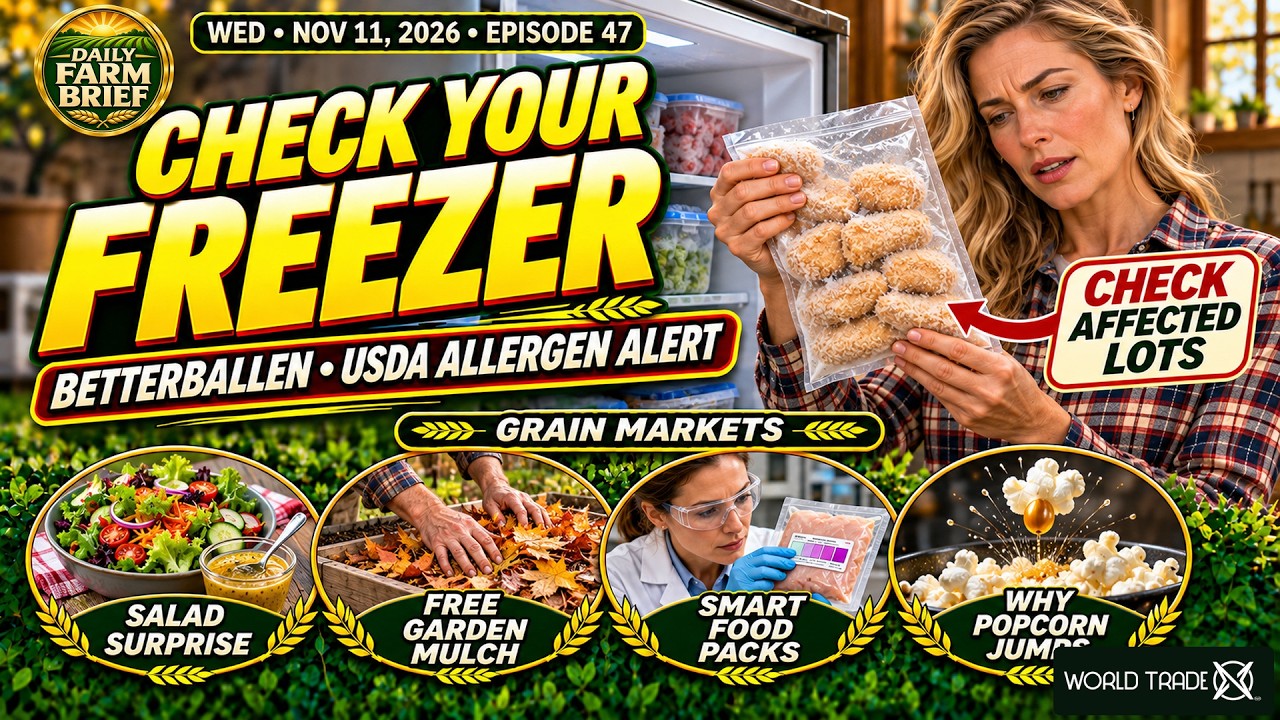
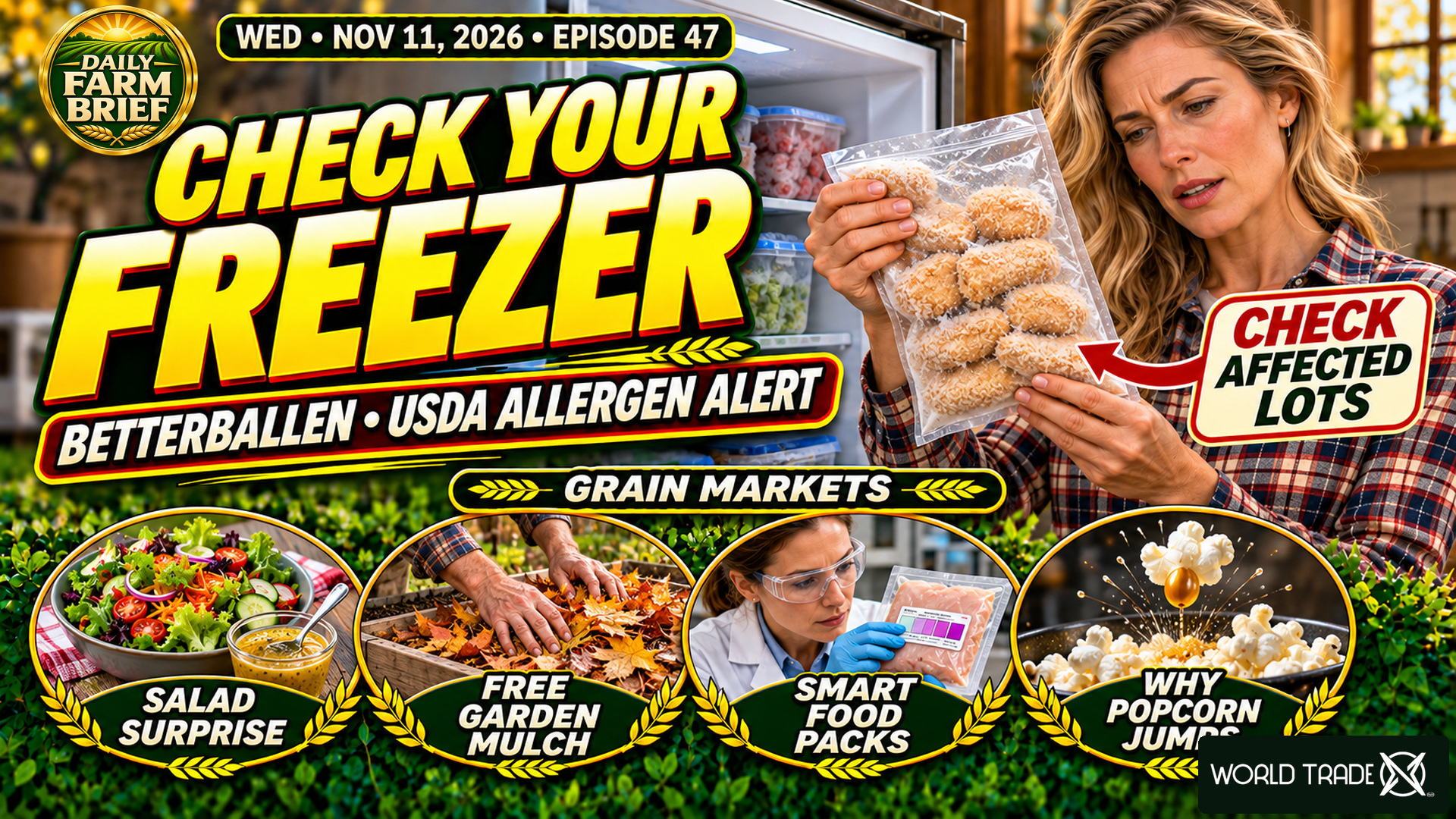
The lead story concerns frozen meat and poultry products from Betterballen Foods LLC. USDA’s Food Safety and Inspection Service issued a public health alert on November 6, 2026, because the labels failed to identify certain allergens.
The products contain undeclared sesame. The beef product also contains Worcestershire sauce made with anchovy, meaning fish was present without the required disclosure.
The distinction between an alert and a recall matters here. FSIS said a recall was not requested because the products were no longer available for purchase. That does not mean every package had been eaten or discarded. Some could still be in home refrigerators or freezers.
These are the products identified in the notice:
| Product | Package | Lot codes |
| Bami Rolls | 6-piece package | BR-2026-01 or BR-2026-02 |
| Saté Kroketten | 10-piece package | SK-1026-01 |
| Bitterballen | 12-piece package | BB-1026- |
All carry a BEST BY date of October 2027. Look for establishment number EST. M3177 or EST. P3177 inside the USDA inspection mark.
The notice describes clear, vacuum-packed packages. Products were sold nationwide online through Lowlands House and may also have been sold at a festival and farmers market in Greer, South Carolina.
Why the sauce matters
A shopper may reasonably think of a beef snack as beef, breading, and seasoning. A sauce inside that recipe can introduce another ingredient entirely. In this case, the connection runs from beef snack to Worcestershire sauce to anchovy.
That is why the full ingredient information matters more than the familiar name on the front. People shopping for someone with an allergy need to know what went into the complete recipe, including sauces and other ingredients that have ingredients of their own.
FDA identifies nine major food allergens: milk, eggs, fish, crustacean shellfish, tree nuts, peanuts, wheat, soybeans, and sesame. Its consumer guidance emphasizes checking ingredient labels and understanding that a “contains” statement and a voluntary “may contain” warning mean different things.
A “contains” statement identifies allergens used as ingredients. A “may contain” statement can warn about possible unintended cross-contact. Neither should be treated as a decorative line of fine print when someone at the table has an allergy.
What to do with a matching package
FSIS urges consumers not to eat the affected products. Return them to the place of purchase or throw them away. At the time the alert was issued, the agency reported no confirmed adverse reactions. Anyone concerned about a reaction should contact a health care provider.
For a practical freezer check, bring the product name, lot number, and inspection mark into the same view. A photo of the packaging can make it easier to compare the details with the official notice or explain what you found when contacting the seller.
And if somebody else in the household bought the food, include them in the check. The person who placed an online order may remember the seller even when another family member does not recognize the brand.
This is a specific alert about specific products. The useful response is to identify those packages accurately and follow the instructions, then share the details with anyone who may have purchased them.
The Salad Surprise: Fat-Free Does Not Answer Every Nutrition Question
You build a salad with leafy greens, carrots, and tomatoes. Then you leave off the dressing because you want to make the healthiest choice possible.
There is an interesting wrinkle in that decision: what is in a vegetable and what the body absorbs from it are related, but different, questions.
In a small Iowa State University study published in 2004, seven adults ate similar salads with dressings containing zero, six, or twenty-eight grams of canola oil. Researchers measured the absorption of several carotenoids, plant compounds that include beta-carotene and lycopene.
The measured absorption was greater with oil-containing dressing than with the fat-free version, and greater with the higher-oil dressing than with the reduced-fat dressing in that experiment.
That is a useful finding, but it needs the right boundaries. Seven participants make a small study. The researchers measured absorption after meals; they did not show that a particular dressing prevents disease or makes people live longer. Nor does the result mean vegetables without dressing have no value.
The practical point is that “fat-free” is only one piece of information. It cannot tell you everything about the nutritional role of a food or how that food fits into the rest of a meal.
A better way to compare the bottles
Start with the serving size. Nutrition numbers usually describe one serving, and the amount you pour may be different. If you use twice the listed serving, you are generally getting twice the listed calories and nutrients.
Then compare sodium, saturated fat, and added sugars across similar portions. FDA recommends using the Nutrition Facts panel to make these comparisons. As a general guide, five percent of the Daily Value or less is low, while twenty percent or more is high.
Here is a simple example: a bottle might look appealing because one number on the front is low. Turn it around, and another number may matter more to your own eating plan. Comparing equal portions makes that tradeoff visible.
There is no need to turn lunch into a research project. The goal is to make a choice based on the whole label and the way you actually eat. A salad can remain an enjoyable meal. You do not have to assume that the most austere-looking version is automatically the best one.
Organic Gardening: Put Fallen Leaves Back to Work
Autumn leaves have a way of turning a beautiful afternoon into a chore. Before every bag goes to the curb, consider whether some of that material could stay in the garden.
University of Minnesota Extension recommends covering cleared raised beds with a two- to four-inch layer of mulch. Shredded leaves are one of the organic materials gardeners can use. That cover helps reduce erosion, suppress weeds, and add organic matter.
Begin with the cleanup that matters: remove diseased plant material. Extension specifically points to problems such as blight-infected tomatoes and vegetables affected by powdery mildew. Healthy debris and diseased debris do not belong in the same casual “leave everything” approach.
Then consider the bed itself. An empty vegetable bed and a perennial border serve different purposes over winter. Minnesota Extension notes that some standing seed heads feed birds, while hollow stems can shelter beneficial insects. Fall cleanup can be selective rather than an effort to make every inch of the yard look bare.
An easy project for the extra leaves
If you have more leaves than your beds need, Iowa State Extension suggests making leaf mold. That is partially decomposed leaf material, useful as mulch in the garden.
A pile about three feet tall and wide can turn into leaf mold over one to two years. Shredding helps it break down faster. This is a patient gardener’s project, not a promise that a fresh pile becomes finished material next weekend.
Iowa State also identifies ordinary composting as another option and recommends a community or commercial composting facility when keeping the leaves at home is impractical.
For an organic garden, the appeal is easy to understand: you are giving a useful material another job. It also makes the project approachable. You can begin with one cleared bed or one manageable pile instead of trying to redesign the whole yard.
Make a note of where you used the leaves and what you notice next season. Gardening gets more interesting when you can connect an autumn decision with a spring result. Sometimes the next useful garden supply is already lying under a tree.
High-Tech Moment: Packaging That Signals a Change
Wouldn’t it be helpful if food packaging could give us more information about what was happening inside?
Researchers at Kyushu University in Japan are investigating that idea with a smart packaging film. Their material combines milk-derived casein, pigments extracted from black soybean seed coats, and additional components.
The film responds to ammonia and other volatile compounds associated with food spoilage. It offers two kinds of signals: a visible color change and a change in fluorescence viewed under ultraviolet light.
In tests involving refrigerated mutton, the researchers reported that the fluorescent response helped indicate freshness changes from an early stage of spoilage. The goal is to improve monitoring and potentially reduce food loss.
This remains research. A spoilage signal is not proof that every possible food hazard has been detected, and this work does not establish a universal package that can pronounce any meal safe.
The promise is more specific, and still interesting: packaging could someday provide a useful additional clue as food changes during storage.
It connects neatly with our lead story. A label tells us what the manufacturer says is in a food. A freshness indicator would try to tell us something about its condition. Both involve information, but they answer different questions. Neither deserves a broader promise than the evidence supports.
The Old Farmer’s Almanac Corner: Why Popcorn Jumps
After labels, research, and garden cleanup, here is a kitchen question that is simply fun: What makes a popcorn kernel leap?
Inside a kernel is moisture surrounded by starch and held within a tough outer hull. As the kernel heats, pressure builds. When the hull finally breaks, the softened starch expands rapidly into the familiar puff.
The Popcorn Board explains that the first starch emerging from the kernel can form a small leg-like structure. As it pushes against the hot surface, it launches the kernel. What looks like a tiny explosion doing a somersault has a physical explanation.
The combination of moisture, starch, and the right hull is what makes popcorn suitable for this trick. Ordinary sweet corn is not a substitute that produces the same fluffy bowl.
That makes popcorn a small reminder of how much is hidden in an everyday crop. We tend to think about corn by the acre or by the bushel. Here, the whole performance takes place inside one kernel.
It is also the kind of story worth sharing with a grandchild across the kitchen counter. You do not need a complicated lesson plan. Start with a familiar snack, ask a question, and let curiosity do the rest. Agriculture has plenty of those little doors into science.
Market Watch: Grains Finished Higher
At Tuesday’s close, November 10, corn, soybeans, and wheat finished higher, with soybeans posting the strongest gain among those three featured contracts.
December corn rose 9¾ cents to $4.49 per bushel. January soybeans gained 39¾ cents to $12.28, while December Chicago wheat added 4¾ cents to $5.9275 per bushel.
Pro Farmer reported that USDA cut its U.S. corn production estimate by 141 million bushels from the previous month. The soybean estimate increased, but by less than traders had expected. Those developments helped support the grain complex.
December live cattle also gained, while December cotton and December lean hogs edged lower. It was an up day for the featured grains, not a uniform move across agriculture.
These figures describe the November 10 market close, not a live quote. The contract month matters when comparing prices. Our expanded video ticker carries the broader market information alongside the stories, then cycles through farm headlines, weather, and the moon phase.
For the spoken wrap, the takeaway was straightforward: strength in grains and cattle, with softer cotton and hogs.
Thank You, Farm Nation and Truck City
This Veterans Day, we also pause to thank the men and women who have served, along with the families who have supported them.
Whether you spent today in a field, behind a steering wheel, working in a shop, or caring for people at home, thank you for spending part of it with Daily Farm Brief.
Find the show and our expanded stories at dailyfarmbrief.com. If you found something useful here, share it with someone who would enjoy the conversation.
I’m Rick Portanova. Daily Farm Brief is supported by World TradeX — Empowering Farmers.
We’ll see you tomorrow morning.

Rick is a broadcaster at heart, having built an internet radio network back in 1993. Back then they were called archived shows (mp3), the term podcast didn't exist but some people were already podcasting and he was one of them. Internet radio fizzled out fast when the Sirius satellites were launched and all the big networks inhaled all the programming. Here we are 30 years later. My how things have changed. Independent media put regular people on the same playing field and news and entertainment changed forever. His passion is being a boat captain and spending every minute with his little girl dog Mandy by his side.
His news delivery style is described as "Hit the fact, explain why anyone would care, make a joke and move on". He tears though things he believes will be worth a listener knowing and hoping he can get them to smile or chuckle. Much of the news is not "Happy news" and he realizes how hard things are for farmers and truckers, so he tries to keep it light and comical because no matter how bad things get we always need to find a way to laugh about it or we'd all go crazy.
If you want a passionate ally to dole out the news while mixing it up with funny short stories and odd side news, you will find his favorite program "Daily Farm Brief" a worthy 10 minutes of you weekday.
Preventing Irrigation Copper Theft: A Guide to Farm Security Tech