Deere to Close 2 Iowa Plants, Spain Buys U.S. Soy & GPS Tracks 17 Stolen Hives, Supermarket Psychology and more
Where Deere’s Iowa Work Goes Next—and the Farm Stories Behind the Headlines
Daily Farm Brief | Friday, November 6, 2026 | EP 44
By Rick Portanova
Deere’s Iowa factory changes raise questions that reach beyond the assembly line. Where will the next baler come from? What happens to the workers who built the last one? And what does a factory move mean for the town around it?
In this edition of Daily Farm Brief, we also follow another soybean order from Spain, explain why cranberries float, look at a pepper study involving soil metals, and explore how flavor changes and grocery displays influence our shopping and eating. Then there’s a beekeeper who hid GPS inside a hive—and the families who turned feed sacks into something worth wearing.
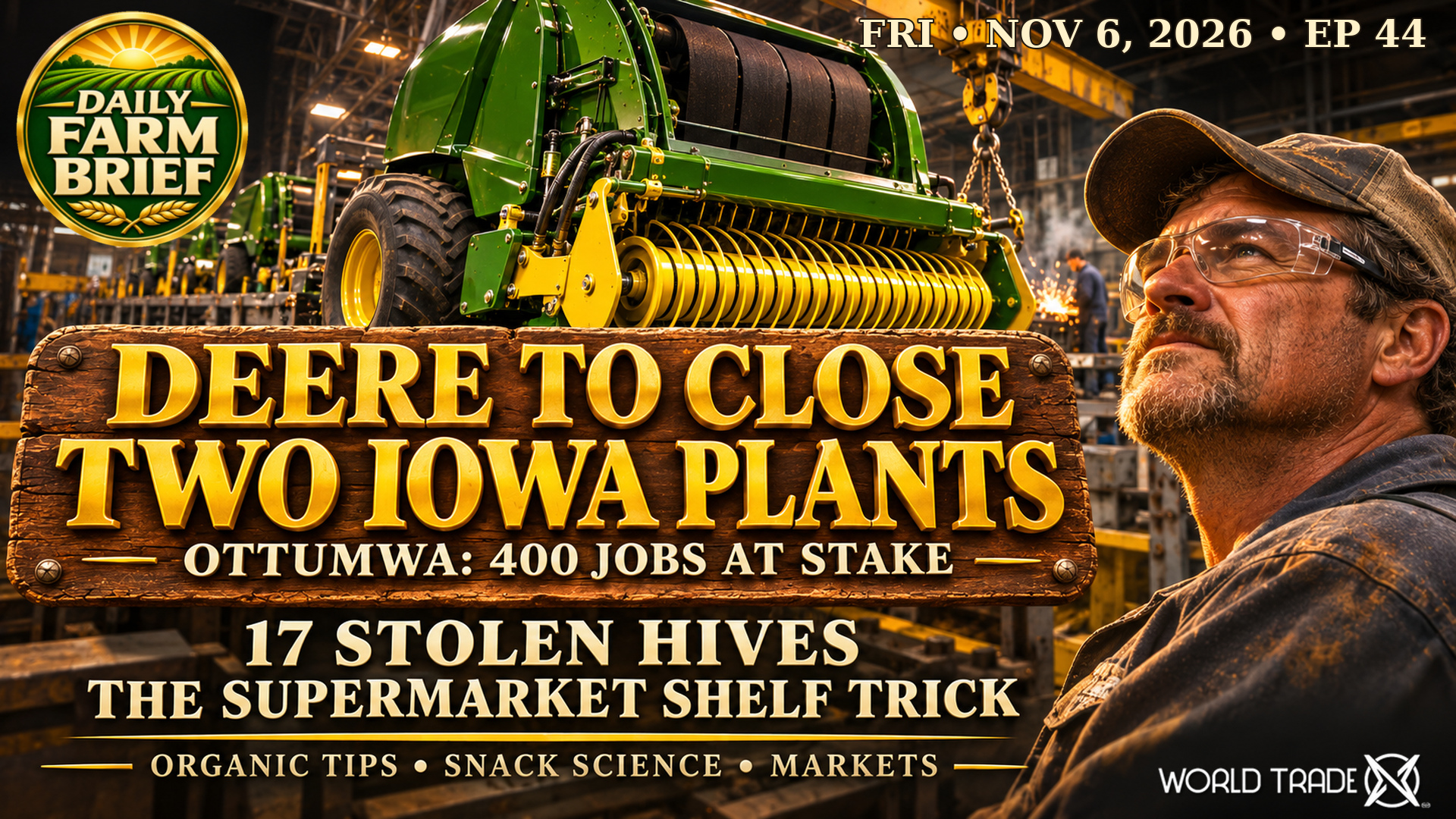
John Deere: Two Iowa Plants, Two Different Destinations
Deere bought its Ottumwa factory in 1911. Now the company has a timetable for moving its remaining production elsewhere.
According to the plan covered in this episode, Deere’s Des Moines Works in Ankeny, Iowa, will take over Ottumwa’s windrower production by the end of fiscal 2027. Windrowers cut hay and lay it in rows for the next operation.
Round baler production is scheduled to follow by the end of fiscal 2028. Deere intends to close the Ottumwa site once both product lines have transferred.
For farmers, the immediate question is how those moves will affect equipment production, availability, and support. For Ottumwa, the stakes include the workers, local businesses, and families connected to the plant. City officials put the community’s exposure at roughly 400 jobs and say they want to help bring another employer to the site.
Clarion’s manufacturing operation has a different destination. Deere plans to move Hagie high-clearance sprayer production to Thibodaux, Louisiana, beginning in fiscal 2028, with manufacturing at Clarion ending by fiscal 2029.
Deere cites customer demand and available room at its other factories.
If you remember the company announcing new American facilities earlier in the year, that is a separate part of the picture. Those January plans included an excavator factory in Kernersville, North Carolina, and a parts distribution center near Hebron, Indiana.
The Iowa balers and sprayers have their own destinations and deadlines. Those details matter when a headline compresses several different business decisions into one sentence.
Spain Comes Back for Another Load of U.S. Soybeans
USDA reported that private exporters booked 167,000 metric tons of U.S. soybeans for Spain on November 4.
That followed an October 21 announcement of another 165,000 metric tons sold to the same buyer country. Both orders are for delivery during the 2026–27 marketing year.
Rounded to the nearest tenth of a million bushels, each booking represents about 6.1 million bushels.
Truck City, here is the view from the driver’s seat: at an illustrative 1,000 bushels per load, the November 4 order alone represents more than 6,000 truckloads.
That comparison helps explain the scale. An export sale announcement records a purchase commitment; the actual movement and delivery can happen later.
For farmers watching demand, the repeat booking is the useful detail. Spain returned for another substantial order within two weeks.
Why Cranberry Growers Flood the Beds
A cranberry harvest can look like somebody turned an entire field into a red lake. But cranberries do not spend their lives growing underwater.
Cranberries grow on low, woody vines. The water arrives as part of the wet-harvest process.
Cut a cranberry across the middle and you can see small chambers inside. Air in those pockets helps the berry float. Growers use that natural feature to collect the crop.
For a wet harvest, they flood the bed and run a harvester through it to loosen the fruit. The berries rise to the surface. A crew then gathers them with a floating boom so they can be loaded out.
Much of the wet-harvested crop goes into products such as juice and sauce.
The whole cranberries headed for a Thanksgiving kitchen generally take a different route. During dry harvesting, a mechanical picker combs the fruit from the vines. The berries then travel in bins for cleaning and packing.
Same fruit, different harvesting job. The bag of whole berries and the bottle of juice offer a useful clue about how each crop may have left the farm.
What Hot Peppers Can Tell Researchers About Soil
At the University of Kentucky’s South Farm in Lexington, a Kentucky State University research team grew Georgia Flame peppers in plots receiving different soil treatments.
The researchers tested amendments that included composted worm castings, manure, and biochar. They collected soil and fruit to measure how metals moved into the plants and the harvested peppers.
The study examined cadmium, nickel, copper, and zinc.
The plants took up metals, while concentrations measured in the harvested fruit remained below the limits cited in the study. Some combinations of biochar and other amendments changed how readily particular metals entered the plants.
That leads to a practical question: How much metal actually leaves a field when the crop is harvested?
Finding metals in a plant is one measurement. Determining whether repeated cropping meaningfully reduces what remains in the soil requires more work.
Repeated harvests, measurements of the harvested material, and follow-up soil testing would help establish whether the amount removed is large enough to matter.
For growers, this is an example of why the details behind a research headline deserve attention. The soil treatment, the particular metal, and the amount taken away in the crop all influence the result.
Sort the Tomato Vines Before They Reach the Wheelbarrow
At the end of the growing season, healthy vines and badly diseased vines can quickly become one tangled pile.
Sort them while you can still tell them apart.
University of Minnesota Extension explains that portions of a backyard compost heap may remain too cool to kill organisms responsible for plant disease.
That creates a possible return trip: diseased material goes into the pile, the finished compost goes onto next year’s tomato bed, and the problem comes along with it.
Healthy plant material can go into the home compost pile. Keep badly diseased material out of that pile.
The easiest time to make the decision is when the vines are still standing and their condition is obvious. Once everything has wilted together in the wheelbarrow, a simple cleanup job becomes a guessing game.
Why a New Flavor Makes Another Bite Sound Good
Ever reach for the ketchup just as you were about to push the fries away?
Researchers studied a version of that situation with 21 participants. The experiment involved fries and brownies, with dips and toppings offered in different arrangements.
People ate more when the eating experience included a change of flavor. Ketchup renewed interest in the fries. Vanilla cream did something similar for the brownie.
Researchers call the underlying effect sensory-specific satiety.
As you continue eating one food, its particular taste can become less appealing. Introduce a different flavor and another bite may suddenly sound interesting.
That is an easy experience to recognize in everyday eating. A mixed-flavor snack bag offers variety without requiring you to open another package. In the episode, Doritos Collisions—Tangy Pickle and Cool Ranch in the same bag—served as a familiar illustration.
The researchers tested fries and brownies. The chips were an everyday comparison, rather than a product tested in that experiment.
The useful takeaway is awareness. When a fresh dip, topping, or flavor makes you want to keep eating, pause long enough to notice what changed.
Before You Buy the Coffee, Turn the Corner
An end-of-aisle display makes a purchase easy. There is the product, there is the price, and there is an open path into your cart.
The alternatives may be a few feet around the corner.
Researchers studying one British grocery store found that coffee sales volume was 73.5% higher when the coffee was displayed at an aisle end, after accounting for price and promotions.
That finding came from one store. It should not be treated as a universal prediction for every supermarket. It does show how much placement can matter in a particular shopping environment.
A separate eye-tracking study found that shoppers paid more attention to upper and middle shelves than to lower shelves.
Here is a practical coffee test:
- Turn into the aisle before choosing from the display.
- Look at the lower shelves, too.
- Compare the price per ounce among products you would actually use.
- Check package sizes so a smaller container does not merely look cheaper.
A large stack on the corner tells you where the store wants your attention. Comparing the available choices tells you which purchase makes sense for your household.
The Tennessee Beekeeper Who Hid GPS in the Honeycomb
In April 2022, Middle Tennessee beekeeper Jon Jones suspected the people stealing his hive boxes might return.
He and his father, Jerry, depended on mature bee colonies that had survived winter. Losing those colonies meant losing far more than wooden equipment.
Jon hid a small GPS device inside the honeycomb of a remaining hive.
When more boxes disappeared, one of them could report where it had gone.
The signal led him to a house. He contacted authorities, and officers served a warrant. According to WTVF’s reporting, they found dozens of hives.
The Jones family recovered 17 hives.
The honey was gone. Some of the boxes needed duct tape. But the bees were alive.
For a beekeeper who had already carried those colonies through winter, that was the part worth bringing home.
When Three Matching Feed Sacks Made a Dress
There was a time when buying chicken feed could also mean choosing fabric for a new dress.
In a Missouri oral history, a woman named Josie remembered her mother asking for a sack at the bottom of a stack. Her mother needed three sacks in the same print to make a dress.
The chickens would eat the feed from any of them. Getting the matching fabric required a little more effort from the person working behind the counter.
Printed cotton sacks gave families two uses from one purchase. After the feed was used, the fabric could become clothing or household goods.
As families sewed with the material, manufacturers had a reason to offer attractive patterns. The print itself could influence which feed went home.
One example survives in the Smithsonian’s collection.
Dorothy Overall of Caldwell, Kansas, entered a floral feed-sack dress in the 1959 National Cotton Bag Sewing Contest. Smithsonian records describe a contest prize that included a trip to Hollywood.
The museum catalogs the surviving dress as a second-place entry in the Mid-South section. Silver-colored stitching runs through fabric that began as packaging.
It is a small piece of farm history with a practical lesson: a purchase could be judged by what it supplied today and what it could become tomorrow.
More Farm Headlines From the Episode Ticker
Crop-Protection Prices: Compare the Actual Quote
A Farmers Business Network comparison put spring crop-protection prices 12.7% above fall prices.
That gives growers a reason to compare seasonal purchasing options. A useful comparison still requires matching the product, application rate, quantity, and purchase terms.
The percentage is a starting point for checking a quote.
Monette Farms Seeks More Time
Monette Farms asked the court to extend creditor protection through November 25 while it completed remaining harvest acres and bids for its real estate were reviewed.
The distinction matters: November 25 was the requested extension date in the coverage discussed in the episode.
Deere Expands Eligible Parts Warranty
Deere’s expanded warranty on eligible original-equipment service and repair parts took effect November 1.
The company describes the coverage as 24 months or 4,000 machine hours, whichever comes first, with unlimited hours during the first 12 months.
Eligibility and warranty terms remain part of the decision when buying a particular repair part.
Fall Nitrogen: Check the Soil
For fall anhydrous ammonia application in Iowa, Iowa State Extension calls for soil temperatures below 50°F at a four-inch depth and continuing to cool.
A cold morning does not establish the temperature at application depth. The ground measurement is the useful number.
BASF’s Weed-Control Announcements
BASF introduced Voraxor for burndown and Zidua PLUS for residual weed management.
Those products appeared together in the headlines, but the episode identified different jobs for each: controlling existing vegetation before planting and managing later weed emergence.
Markets and Fuel: The Episode’s Dated Snapshot
These are the readings displayed in EP 44, rather than live quotes.
The early Thursday snapshot had wheat and soybeans higher, corn steady, and cattle and milk lower. By the ticker’s November 5 readings at approximately 11:08–11:10 a.m. Central, corn and soybeans had slipped below their previous settlements.
That movement is why a futures quote needs both a contract month and a timestamp.
Grains and Oilseeds
| Contract | Price shown | Change |
|---|---|---|
| Corn — December 2026 | $4.405 per bushel | −3.75¢ |
| Soybeans — January 2027 | $11.920 per bushel | −10.25¢ |
| Chicago wheat — December 2026 | $5.9975 per bushel | +1.25¢ |
| Kansas City hard red winter wheat — December 2026 | $6.365 per bushel | +3.75¢ |
| Spring wheat — December 2026 | $6.2075 per bushel | +4.00¢ |
| Oats — December 2026 | $3.330 per bushel | −3.25¢ |
| Canola — January 2027 | C$754.90 per tonne | −C$13.40 |
| Soybean meal — December 2026 | $317.50 per short ton | −$1.10 |
| Soybean oil — December 2026 | 62.15¢ per pound | −1.38¢ |
| Rough rice — January 2027 | $18.205 per hundredweight | +$0.150 |
Livestock and Dairy
| Contract | Price shown | Change |
|---|---|---|
| Live cattle — December 2026 | $213.800 per hundredweight | −$4.200 |
| Feeder cattle — January 2027 | $318.175 per hundredweight | −$7.550 |
| Lean hogs — December 2026 | $54.675 per hundredweight | −$2.875 |
| Class III milk — December 2026 | $16.81 per hundredweight | −$0.28 |
| Cash-settled cheese — November 2026 | $1.68 per pound | −$0.04 versus October 28 |
Energy and National Pump Prices
| Reading | Price shown | Change |
|---|---|---|
| WTI crude oil — December 2026 | $90.43 per barrel | +$2.31 |
| Henry Hub natural gas — December 2026 | $2.978 per MMBtu | +$0.019 |
| National on-highway diesel — November 2 | $6.292 per gallon | −$0.060 |
| National regular gasoline — November 2 | $4.153 per gallon | −$0.116 |
Agricultural futures changes compare with the prior settlement. Cheese uses the November 4 settlement compared with October 28. Energy prices reflect the November 5 delayed reading at 12:19 p.m. Eastern. National diesel and gasoline prices are the November 2 EIA weekly averages.
A hundredweight is 100 pounds. MMBtu means one million British thermal units.
Friday Weather and the Moon
The episode’s Friday outlook called for light rain at lower elevations in the Pacific Northwest, with snow in the mountains.
A second front was expected to bring cooler air and some precipitation to the central and southern High Plains.
Rain could reach southern New England on Friday, although the western edge of that precipitation remained uncertain.
In the Southeast, areas behind the front could expect cooler, drier air.
Friday’s moon is a waning crescent.
Keep Up With Daily Farm Brief
Thanks for spending part of your day with us, Farm Nation and Truck City.
Find Daily Farm Brief and our detailed matching episode blogs at dailyfarmbrief.com.
Rick Portanova — Daily Farm Brief
Brought to you by World TradeX. Empowering Farmers.

Rick is a broadcaster at heart, having built an internet radio network back in 1993. Back then they were called archived shows (mp3), the term podcast didn't exist but some people were already podcasting and he was one of them. Internet radio fizzled out fast when the Sirius satellites were launched and all the big networks inhaled all the programming. Here we are 30 years later. My how things have changed. Independent media put regular people on the same playing field and news and entertainment changed forever. His passion is being a boat captain and spending every minute with his little girl dog Mandy by his side.
His news delivery style is described as "Hit the fact, explain why anyone would care, make a joke and move on". He tears though things he believes will be worth a listener knowing and hoping he can get them to smile or chuckle. Much of the news is not "Happy news" and he realizes how hard things are for farmers and truckers, so he tries to keep it light and comical because no matter how bad things get we always need to find a way to laugh about it or we'd all go crazy.
If you want a passionate ally to dole out the news while mixing it up with funny short stories and odd side news, you will find his favorite program "Daily Farm Brief" a worthy 10 minutes of you weekday.
Preventing Irrigation Copper Theft: A Guide to Farm Security Tech