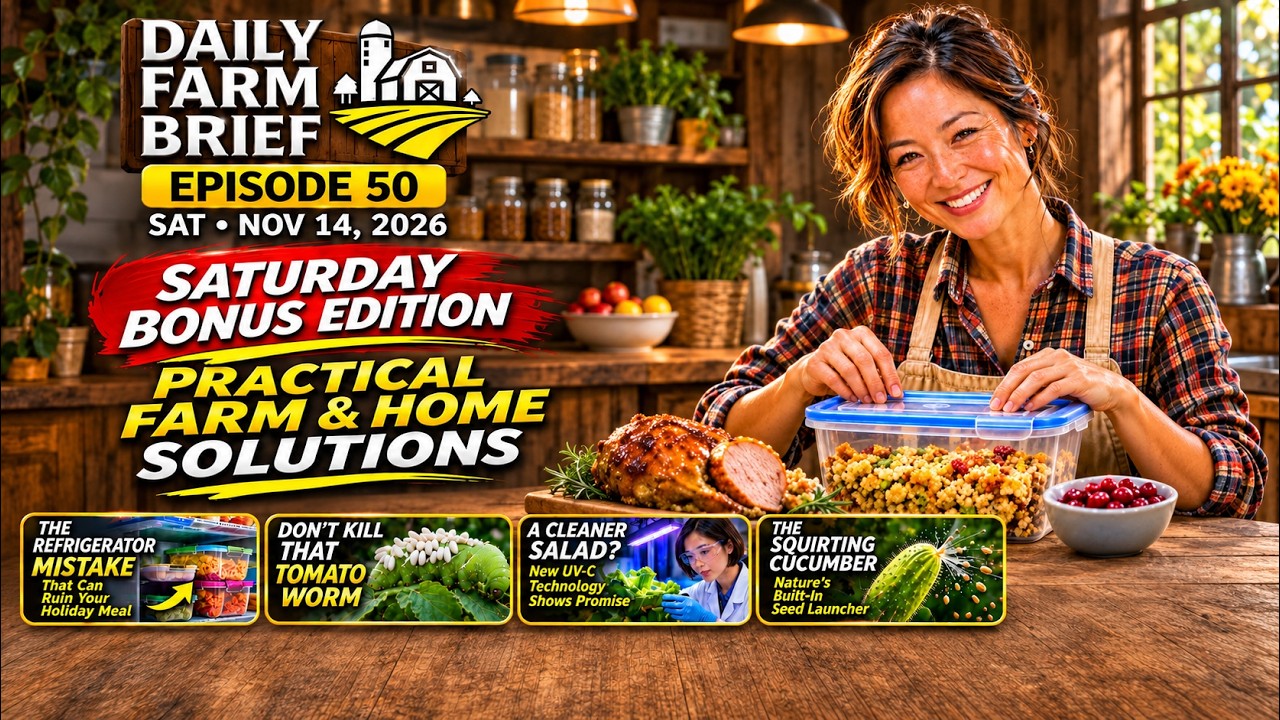
CHEDDAR CHEESE RECALL! Thanksgiving Leftover Mistakes, Tomato Worm Helpers & Seeds That Shoot 45 MPH
Safer Holiday Meals, Smarter Gardening, and a Cucumber With a 45-MPH Surprise
Daily Farm Brief • Episode 50 • Saturday, November 14, 2026
By Rick Portanova
A beautiful holiday meal can take days to plan, hours to cook, and only a few minutes to become everybody’s favorite memory of the weekend. Protecting that meal takes some attention after the plates are cleared, too.
In this Saturday bonus edition of Daily Farm Brief, we’re looking at the small details that deserve a closer look. There’s a cheese recall to check before serving guests. There’s a simple way to get more value from your holiday grocery budget. And there’s a refrigerator habit that can make a difference when everyone starts asking what’s for lunch tomorrow.
Then we’ll head outside, where a tomato-eating caterpillar may be carrying a gardener’s helper. We’ll explore research into using light to improve salad safety and finish with a plant that launches its seeds at about 45 miles an hour.
Good morning, Farm Nation, and hello, Truck City. Grab your coffee, and let’s get into it.
Check the Cheese Before It Reaches the Holiday Table
Our first headline concerns Family Farmstead Dairy’s recall of raw mild and raw sharp cheddar cheese because of possible Listeria contamination.
The company announcement posted by the FDA on November 10 identifies 8-ounce, plastic-wrapped packages of Raw Mild Cheddar and Raw Sharp Cheddar with dates of October 16, 2027, and earlier. The notice covers all lot codes within that date range.
The cheese was distributed through retail stores in New York, New Jersey, Vermont, New Hampshire, Massachusetts, Pennsylvania, Rhode Island, Connecticut, Delaware, Virginia, West Virginia, and Tennessee. Consumers with affected products can return them to the place of purchase or contact the company for assistance at 607-397-4044. Check your package against the FDA notice before serving it. (fda.gov)
That deserves particular attention when you’re preparing food for older relatives or guests with weakened immune systems. The CDC identifies adults 65 and older, pregnant people, newborns, and people with weakened immune systems as groups at increased risk from Listeria infection. (cdc.gov)
A holiday refrigerator can get crowded quickly. Cheese for an appetizer tray may have been purchased well ahead of the gathering, tucked into a drawer, and forgotten until company arrives. Checking that package while planning the menu gives you time to make another choice.
Holiday Food Waste Takes a Bite Out of the Grocery Budget
Our second headline touches nearly every household.
Johns Hopkins researchers highlighted holiday food safety and food waste in a November 10 briefing. Their message included a striking estimate. The average American household of four spends more than $2,900 a year on food that goes uneaten. They also noted that food waste increases around the holidays, particularly Thanksgiving. (publichealth.jhu.edu)
It’s easy to understand how it happens. Everyone brings something. The guest list changes. We buy extra because we want people to feel welcome. Then several containers disappear behind the milk, and a week later we’re trying to remember what’s inside.
A little planning can preserve the generosity while making the food easier to use.
Before shopping, look through the refrigerator, freezer, and pantry. Build your list around the number of people coming and the meals you actually expect to serve afterward. EPA guidance recommends planning quantities, using ingredients already on hand, and making room for leftovers in upcoming meals. (epa.gov)
For example, decide ahead of time whether leftover turkey is headed for sandwiches, soup, or the freezer. That decision makes it easier to divide the food into useful portions when you put it away.
You can also assign a small job to someone who offers to help. One person can gather containers while another clears plates. Having lids, labels, and refrigerator space ready turns a tired, end-of-dinner chore into a manageable few minutes.
For the farmers and truckers in our audience, there’s another reason this matters. You understand the effort behind a meal long before it reaches a kitchen. Using that food well is a satisfying way to respect the work that brought it home.
The Leftover Mistake That Can Spoil a Good Meal
You can cook the turkey beautifully, get the stuffing exactly right, and still run into trouble afterward.
The familiar scene is easy to picture. Dinner is finished, someone starts making coffee, a football game gets interesting, and the serving dishes remain on the table. People wander back for another bite. Cleanup keeps getting pushed a little further down the afternoon.
Perishable food needs to be refrigerated within two hours. If the surrounding temperature is above 90°F, that window shrinks to one hour.
USDA guidance applies that rule to home-cooked food and restaurant leftovers, including meat, poultry, egg dishes, side dishes, and casseroles. Perishable food left at room temperature beyond those limits should be discarded. (ask.fsis.usda.gov)
For a holiday gathering, give someone responsibility for watching the time. Count from when the food leaves proper temperature control, such as an oven or equipment keeping it safely hot. Coming back for another helping leaves the original timing in place.
Picture a casserole that reaches the table at two o’clock. By four, the two-hour window has passed. The fact that somebody took a spoonful at three-thirty doesn’t give that dish another two hours.
A normal smell also cannot establish that food is safe. The FDA explains that illness-causing bacteria can be present even when food looks, smells, and tastes normal. Storage history matters. (fda.gov)
That’s why a clock and a plan are so helpful. They give you something dependable to work with when the kitchen gets busy.
Give Leftovers a Head Start on Cooling
The next improvement is simple. Divide large amounts of food into smaller portions and shallow containers before refrigerating.
USDA says small amounts of hot food can go directly into the refrigerator. A large pot of soup or stew should be portioned into shallow containers. Large cuts of meat and whole poultry should also be divided into smaller pieces for storage. These steps help food cool more effectively. (ask.fsis.usda.gov)
This is particularly useful after a big family meal, when the largest serving dishes are often the least convenient containers to refrigerate.
Think about tomorrow’s portions as you put today’s food away. A shallow container of sliced turkey is easy to reach for at lunch. Several modest portions of casserole are easier to organize than one enormous dish competing for an entire refrigerator shelf.
Make that space before the meal begins. Move beverages somewhere appropriate, straighten the shelves, and gather matching containers and lids. You’ll be grateful for those few minutes of preparation when the kitchen is full of people.
The refrigerator itself needs attention, too. Keep it at 40°F or below, and leave enough room for cold air to circulate. An appliance thermometer lets you check the actual temperature. The FDA recommends monitoring temperatures rather than relying only on the refrigerator’s control setting. (fda.gov)
Put a Date on Tomorrow’s Lunch
Once leftovers are stored safely, make them easy to identify.
Write the food’s name and the date on the container. “Turkey — Thursday” gives you something concrete when several meals have passed and everybody’s memory has become a little optimistic.
USDA recommends using refrigerated leftovers within three to four days, or freezing them for longer storage. Keep frozen food at 0°F. Smaller portions also let you take out an amount that fits the meal you’re preparing. (ask.fsis.usda.gov)
When reheating leftovers, USDA recommends reaching an internal temperature of 165°F, checked with a food thermometer. Bring soups, sauces, and gravies to a boil. For microwave reheating, cover, stir, or rotate the food as appropriate, allow standing time, and check that it has heated thoroughly. (ask.fsis.usda.gov)
A useful holiday habit is to decide early which portions you expect to eat within the next few days. Freeze the extra portions promptly while you’re already organizing the kitchen.
That gives the meal a second life you can actually enjoy. A labeled container in the freezer is also a welcome sight on an evening when nobody feels like starting dinner from scratch.
The Tomato Hornworm Worth Leaving in the Garden
Now let’s head outside.
Imagine finding a large green caterpillar on a tomato plant you’ve spent months tending. Leaves are missing. A stem looks suspiciously bare. Your first reaction is probably to remove the culprit.
Before you do, look at its back.
A hornworm carrying little white, rice-shaped structures may be hosting beneficial parasitic wasps. Those white structures are the wasps’ cocoons.
University of Minnesota Extension describes how the wasp’s young develop inside the hornworm, emerge, and form cocoons on its body. Once the adults emerge, they can seek other hornworms. Extension recommends leaving these parasitized caterpillars in the garden so the wasps can complete their development. (extension.umn.edu)
That small detail can change your decision.
Hornworms can strip foliage and damage fruit. A caterpillar carrying those cocoons, however, is also supporting the next generation of insects that help manage the pest. University of Maryland Extension likewise advises gardeners to preserve parasitized hornworms and allow the wasps’ life cycle to continue. (extension.umd.edu)
This is a practical organic gardening lesson because it begins with observation. Before choosing a treatment, take a moment to identify what’s happening on the plant.
Look at the damaged leaves. Examine the caterpillar. Take a clear picture if you want help identifying it. Your local Extension office can be a useful resource when you’re uncertain.
The more familiar you become with your garden, the more often you notice these small relationships. A plant can hold pests, predators, and developing beneficial insects at the same time.
For readers whose tomato season has already ended, save this picture in your mind for next year. Green caterpillar. White, rice-like cocoons. Pause and look closely.
That extra moment may let the garden’s own pest-control process continue.
Could Light Help Make Packaged Salads Safer?
A bag of salad greens is one of the easiest ways to get vegetables onto a busy family’s table. Behind that convenience is a complicated food-safety challenge.
Researchers are examining how ultraviolet-C light, or UV-C, could help improve the safety of ready-to-eat salads. A recent review involving USDA Agricultural Research Service and Washington State University researchers explored practical approaches to using the technology. (ars.usda.gov)
The attraction is understandable. Researchers want treatments that reduce harmful microorganisms while preserving the qualities shoppers want in fresh produce.
But a lettuce leaf presents an uneven surface. It has folds, ridges, and places where one leaf overlaps another. Those areas can create shadows that limit exposure to light. In water-based systems, particles and other material can also interfere with light transmission.
The review examines these limitations and the importance of treatment conditions. Researchers must consider the dose, exposure, produce quality, and how UV-C might work alongside other approaches. (onlinelibrary.wiley.com)
It’s the kind of research worth following because progress can happen through improvements at several points in food production. A technique that works under carefully controlled conditions still needs practical evaluation for the food, equipment, and process involved.
For shoppers, there’s a useful label-reading habit available right now.
California’s public-health guidance says sealed leafy-green products labeled “washed,” “triple washed,” or “ready-to-eat” generally can be eaten without additional washing unless the label directs otherwise. Products requiring washing should be handled according to their instructions. (cdph.ca.gov)
Keep paying attention to those directions as processing methods evolve. A few words on the package tell you how that particular product is intended to be handled.
The Cucumber That Launches Seeds at About 45 MPH
We’ll finish with a plant that gives seed dispersal a little excitement.
The Mediterranean squirting cucumber, Ecballium elaterium, ejects its seeds in a pressurized jet of liquid. Researchers from Oxford and Manchester investigated how the system works using high-speed video, experiments, imaging, and mathematical models.
The launch happens astonishingly quickly. Oxford’s account describes an event lasting about 30 milliseconds, with seeds reaching around 20 meters per second. That’s roughly 45 miles an hour. Seeds can land about 10 meters away, or approximately 33 feet. (ox.ac.uk)
The preparation is just as interesting as the launch.
As the fruit develops, pressure builds. Before dispersal, some fluid moves from the fruit into the stem. The stem becomes longer, thicker, and stiffer, helping position the fruit at an effective angle.
When the ripe fruit separates, seeds shoot out with the liquid. The pressure changes as the fruit empties, and the fruit’s movement changes the launch angle. Together, those effects help distribute seeds across different distances. (ox.ac.uk)
The Manchester researchers used their experiments and models to examine how each stage contributes to that dispersal. It takes careful measurement to understand something that happens too quickly for an ordinary glance to catch. (manchester.ac.uk)
That’s part of the appeal of this story. You can look at a modest little plant and miss the remarkable process happening right in front of you.
Farmers and gardeners spend plenty of time dealing with what plants need from us. Every so often, it’s enjoyable to stop and appreciate what a plant has figured out on its own.
A Few Small Details Worth Remembering
This weekend’s episode leaves us with several things we can use immediately.
Check the cheese before assembling the appetizer tray. Make a plan for leftovers while you’re planning the meal. Have the containers ready, watch the time, and give tomorrow’s lunch a clear date.
When the next gardening season arrives, take a closer look at that caterpillar before deciding what to do. And keep an eye on the researchers working to make familiar foods safer.
There’s room for a little wonder along the way, too. A cucumber firing seeds across the garden is a pretty good reminder of that.
Thank you for spending part of your weekend with Daily Farm Brief. If you enjoyed this episode, please like, follow, and share it with someone who would enjoy it, too.
I’m Rick Portanova. We’re brought to you by World TradeX — Empowering Farmers.
I’ll see you Monday.

Rick is a broadcaster at heart, having built an internet radio network back in 1993. Back then they were called archived shows (mp3), the term podcast didn't exist but some people were already podcasting and he was one of them. Internet radio fizzled out fast when the Sirius satellites were launched and all the big networks inhaled all the programming. Here we are 30 years later. My how things have changed. Independent media put regular people on the same playing field and news and entertainment changed forever. His passion is being a boat captain and spending every minute with his little girl dog Mandy by his side.
His news delivery style is described as "Hit the fact, explain why anyone would care, make a joke and move on". He tears though things he believes will be worth a listener knowing and hoping he can get them to smile or chuckle. Much of the news is not "Happy news" and he realizes how hard things are for farmers and truckers, so he tries to keep it light and comical because no matter how bad things get we always need to find a way to laugh about it or we'd all go crazy.
If you want a passionate ally to dole out the news while mixing it up with funny short stories and odd side news, you will find his favorite program "Daily Farm Brief" a worthy 10 minutes of you weekday.
Preventing Irrigation Copper Theft: A Guide to Farm Security Tech