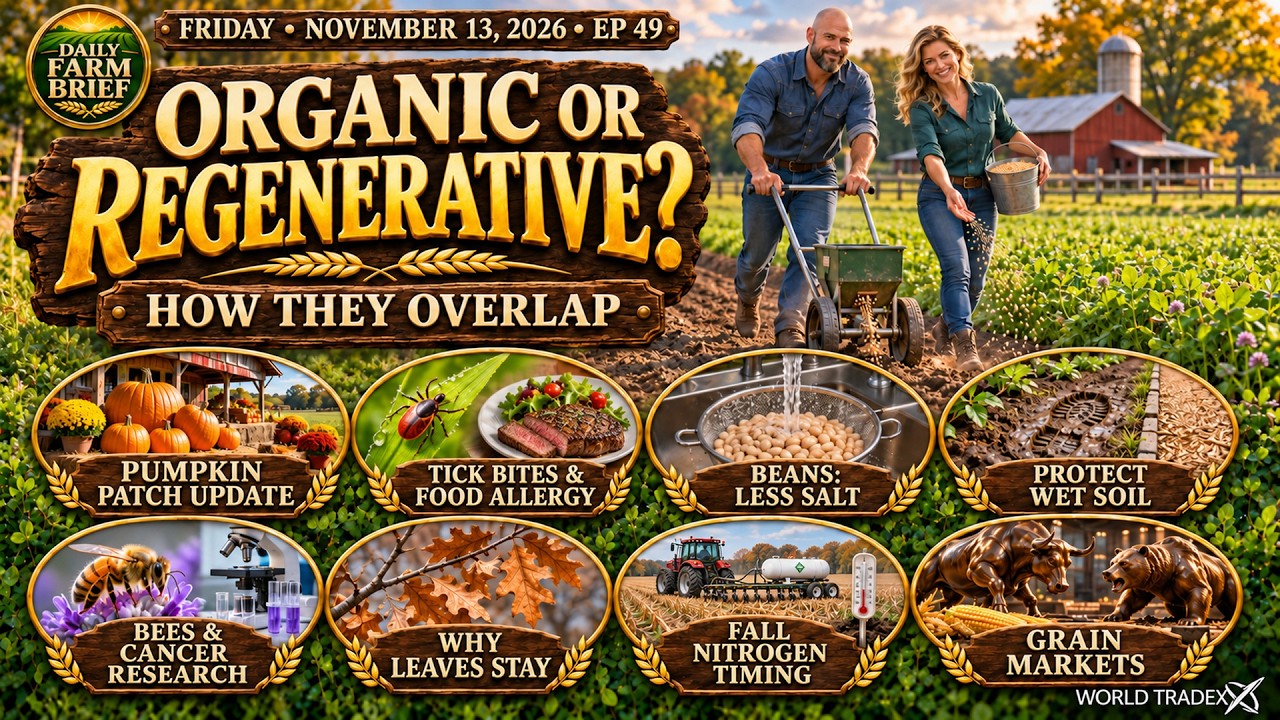
CA Pumpkin Patch Fatality, Tick Bite Meat Syndrome, Bees detect Cancer, Regenerative vs Organic Farming
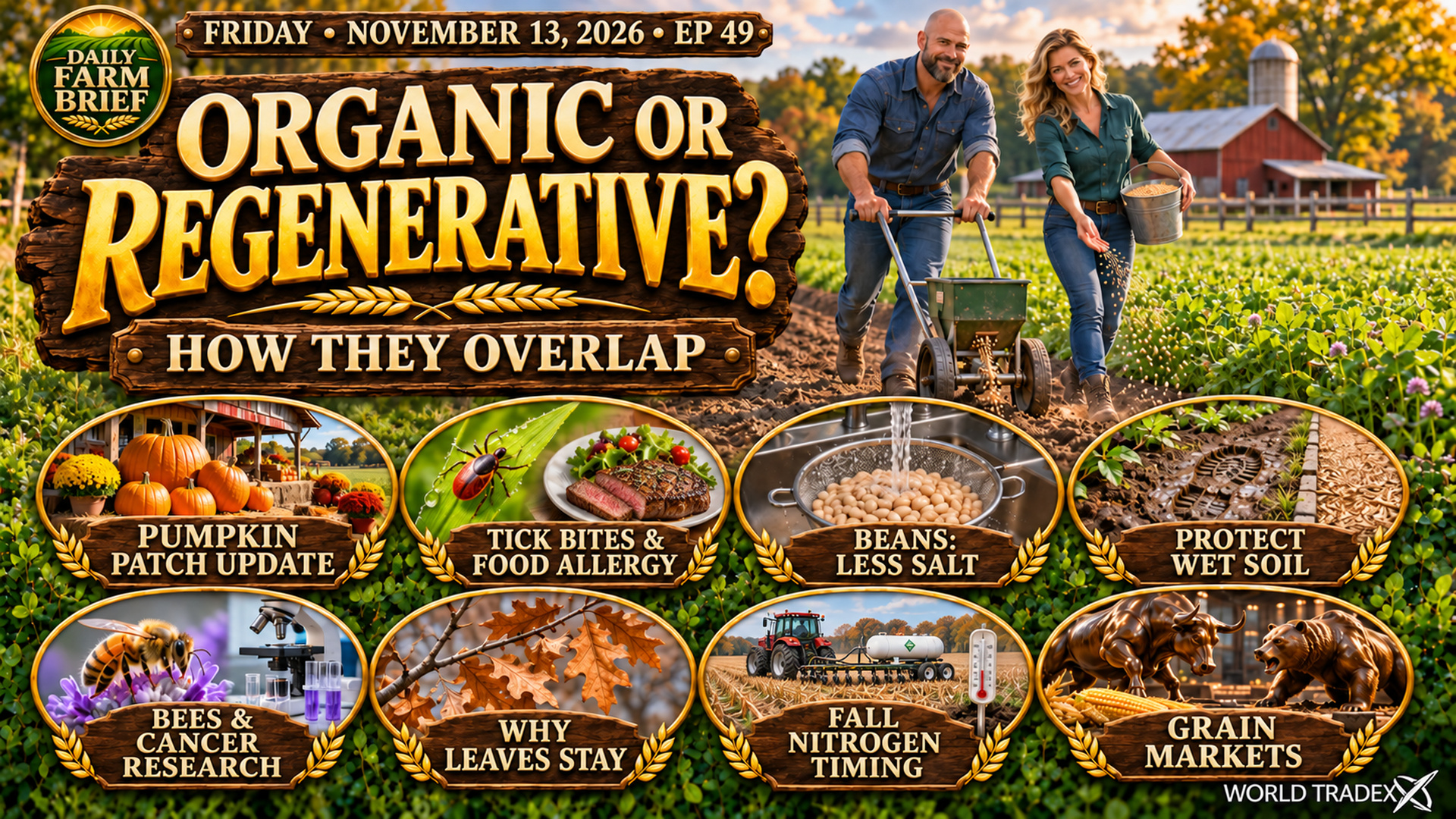
Regenerative and organic
Caring for the soil we share
What the labels verify, and practical choices from field to table.
By Rick Portanova
Picture a field after harvest, with a cover crop growing where the ground might otherwise be bare. Across the fence, cattle have moved while the last paddock rests. Begin the regenerative conversation here: with the work happening on the land.
Noble Research Institute describes regenerative agriculture as restoring degraded soils through ecological principles. Its approach considers soil, water, plants, animals and people together, with management adapted to the particular farm. The aim is improvement over time. A practice that helps in one setting may need a different timing or design somewhere else. [1]
Where USDA Organic fits
USDA Organic identifies production and handling that meet federal standards, verified by an accredited certifier. The rules cover permitted materials and management methods. For crops, for example, land must have had no prohibited substances applied for at least three years before an organic harvest. Pest management begins with physical, mechanical and biological approaches; some specifically allowed materials may also be used. [2]
Soil care is part of organic production, too. Federal rules require tillage and cultivation practices that maintain or improve the soil's physical, chemical and biological condition while minimizing erosion. They also address rotations, cover crops and the careful use of plant and animal materials. It would be misleading to describe organic as having no soil-health requirements. [3]
| USDA ORGANIC | REGENERATIVE |
|---|---|
| A defined, regulated production label with certification requirements. | An approach centered on improving land health; ask which practices, results and verification support a particular claim. |
The two can overlap on the same farm. Regenerative practices by themselves do not establish organic certification. For a shopper, the USDA Organic seal answers a specific certification question. For a producer describing regenerative work, useful follow-ups are: What changed? What are you watching? How will you know the land is improving? [1-3]
FROM THE FIELD TO THE BACKYARD
Timing is part of soil care
A useful soil decision is often a decision about when to act. The regenerative discussion encourages attention to the whole setting: weather, living plants, soil condition and the needs of the operation. That is more demanding than choosing a fashionable word, but it also gives farmers something practical to work with. [1]
Quick farm headline: let the soil temperature lead
Fall fertilizer work can fit a busy farm's labor schedule. Where fall anhydrous ammonia is recommended, however, that convenience has to be weighed against the potential for nitrogen loss. Iowa State Extension advises delaying application until average soil temperature is below 50 degrees Fahrenheit and trending lower. [4]
The reason is underground. After application, nitrogen in the ammonium form can be converted to forms more vulnerable to leaching. Cooler soil slows that process; a date on the calendar does not tell the whole story. Iowa State's guidance specifies a four-inch measurement near 10 a.m. or 7 p.m. in its setting. Follow your own area's extension recommendations for suitability, sampling and conditions. [4]
The useful question is whether the soil is cool enough and continuing to cool. One chilly morning is a poor substitute for checking the trend. This is timing guidance, not a promise of a fixed percentage of fertilizer savings. Weather and field conditions still matter. [4]
Home and garden: read the footprint
You can bring the same patience into a vegetable garden. If a boot leaves a deep impression in a soggy growing bed, consider whether today's job can wait. Walking or cultivating wet soil can press its particles together and damage its structure. The spaces between those particles are valuable: they allow air and water to move and give roots room to grow. [5]
University of Maryland Extension recommends preventing compaction, including by directing foot traffic onto defined paths. Soil with more clay is especially prone to compaction. Instead of making a new shortcut through the bed each time, choose a route and keep the growing area clear. [5]
After rain, use the path to check on the garden and let the wet bed dry before digging or turning it. Around established trees and mature shrubs, avoid treating aggressive cultivation as a simple repair: Maryland Extension warns that working organic matter into those root areas is not recommended. Prevention is easier than correction. [5]
FARM NEWS AND FARM HEALTH
Updates that deserve care
Brookshire Farms: what is confirmed
There is a difficult update from near San Luis Obispo, California. County health officials have confirmed one death associated with the E. coli outbreak linked to Brookshire Farms. They have not released the person's age. [7]
The county's November 6 update lists five laboratory-confirmed E. coli O157 infections and ten additional suspected cases. All five confirmed patients visited October 17 or 18. Food, water and environmental samples did not identify the specific source. Officials described sampling limitations and said contamination can be temporary. [6]
No particular food, pumpkin or water source was established as the cause. The county said no farm animals or petting zoos were available to the public or operating on the premises. On November 6, officials said the incident no longer posed an ongoing public-health threat. [6]
The farm reopened November 6, offered free pumpkins November 7-8, then announced a seasonal closure to prepare for Christmas-tree sales beginning November 27. Permanent closure has not been announced. Our thoughts are with the family and everyone affected. [7-8]
Alpha-gal: when a familiar supper brings a surprise
Hives several hours after dinner can be hard to connect with the meal. One possible explanation is alpha-gal syndrome, a potentially serious allergy that can develop after a tick bite. Alpha-gal is a sugar found in most mammals, including cattle and pigs. Beef, pork and other mammal-derived products can trigger reactions in affected people, although triggers and severity vary. [9]
CDC says symptoms usually appear two to six hours after exposure to foods or products containing alpha-gal. A person may not react the same way every time. The delay is a reason to tell a healthcare professional about unexplained reactions after meals and possible tick exposure; it is not a way to diagnose the allergy yourself. [9-10]
After work or recreation in brush, grass or wooded areas, check your body, clothing and gear for ticks. CDC notes that exposure can occur year-round, including in a backyard. Make the check part of coming indoors, alongside taking off the work boots. Not every tick bite causes alpha-gal syndrome. [9,11]
WHAT ARE WE EATING? | HIGH-TECH MOMENT
A better bowl, a curious bee
Canned beans can earn their place in supper
There is a pot on the stove and a can of beans on the counter. That can is useful: dinner does not always leave time for a long soak and a slow simmer. The practical question is what you want in the bowl, including how much sodium comes along with it.
Tufts Health & Nutrition Letter reports that draining and rinsing canned beans reduced sodium by 41 percent on average in one study. That is the basis for the episode's rounded 'about 40 percent' figure. It is an average from a study, not a guarantee for every brand, bean or kitchen method. Drain, rinse with water and drain again before adding the beans. [12]
Rinsing also carries away some water-soluble nutrients, but Tufts notes that plenty remain, including fiber. A can of beans does not become a bad food simply because it has been processed. Judge the actual product and how it fits your meal, rather than treating every packaged food as the same choice. [12]
Compare sodium using equal serving sizes. If the canning liquid is going into your chili or soup, choose no-salt-added or a lower-sodium version at the store. FDA explains that 'no salt added' does not necessarily mean sodium-free. The Nutrition Facts panel is still worth reading. Herbs and spices can add flavor while you decide how much extra salt the pot needs. [13]
A honeybee's sense of smell enters the laboratory
The bee visiting a garden flower has a sensory system that interests researchers far beyond the garden. In a study announced by Michigan State University in June 2024, a team used tiny electrodes to record neural responses in honeybees exposed to carefully prepared odors. [14]
The researchers mixed six compounds at different concentrations to create synthetic breath samples representing healthy breath and breath associated with lung cancer. Around 20 bees were tested with those mixtures. Differences in the recorded brain signals allowed the researchers to distinguish them. A separate part of the work examined odors from cancer-cell cultures and healthy cells. [14-15]
This was laboratory work with mixtures and cell cultures, not a clinical screening program diagnosing people. The finding is interesting because a biological sense of smell can provide information that might guide future sensing technology. Turning a laboratory result into a useful medical test requires further research and validation.
THE OLD FARMER'S ALMANAC | MARKET WATCH
Winter leaves and Thursday's close
Listen to the oak after the rest of the woods goes quiet
A winter breeze can find plenty to rattle in an oak or beech even after nearby trees are bare. Those dry brown leaves have a name attached to their persistence: marcescence. Some deciduous trees retain dead leaves through winter, with leaf separation delayed until later. [16]
Illinois Extension notes that young oaks and beeches are especially likely to keep their foliage. Some oak species can retain it as mature trees, too. The tree has not become an evergreen just because its branches still carry leaves; those brown leaves are different from a living green canopy. [16]
Why hold them? Researchers have proposed several advantages, including discouraging browsing animals and delaying the return of leaf material to the soil until spring. Those are explanations under discussion, not a single settled purpose for every tree. [16]
On your next walk, compare a young beech with the taller trees around it. Watch when the leaves finally let go. It is a little winter discovery worth sharing with a child or grandchild.
Thursday's grain close | November 12, 2026
Corn, soybeans and Chicago wheat all settled lower in the three featured contracts, with wheat recording the largest percentage decline. These are the Thursday settlements carried into Friday's edition, not live Friday quotes. [17]
| FUTURES CONTRACT | SETTLEMENT | DAILY CHANGE |
|---|---|---|
| Corn | December 2026 | $4.4250 / bu | -5.50 cents / bu |
| Soybeans | January 2027 | $12.1900 / bu | -11.75 cents / bu |
| Chicago wheat | December 2026 | $5.8425 / bu | -15.25 cents / bu |
Keep the delivery month attached to each number. Futures quotations are a reference point, not a cash bid from your local elevator. One day's change does not predict the next session.
A useful question to take into the weekend
Ask what is happening beneath the label or the soil surface. A farmer can explain a management change. A shopper can compare two cans. A gardener can leave a wet bed alone for another day.
Thanks for spending part of your morning with Daily Farm Brief. Share the episode with someone who enjoys a useful question, and find the matching stories at dailyfarmbrief.com.
By Rick Portanova | Daily Farm Brief
Presented by World TradeX - Empowering Farmers.

Rick is a broadcaster at heart, having built an internet radio network back in 1993. Back then they were called archived shows (mp3), the term podcast didn't exist but some people were already podcasting and he was one of them. Internet radio fizzled out fast when the Sirius satellites were launched and all the big networks inhaled all the programming. Here we are 30 years later. My how things have changed. Independent media put regular people on the same playing field and news and entertainment changed forever. His passion is being a boat captain and spending every minute with his little girl dog Mandy by his side.
His news delivery style is described as "Hit the fact, explain why anyone would care, make a joke and move on". He tears though things he believes will be worth a listener knowing and hoping he can get them to smile or chuckle. Much of the news is not "Happy news" and he realizes how hard things are for farmers and truckers, so he tries to keep it light and comical because no matter how bad things get we always need to find a way to laugh about it or we'd all go crazy.
If you want a passionate ally to dole out the news while mixing it up with funny short stories and odd side news, you will find his favorite program "Daily Farm Brief" a worthy 10 minutes of you weekday.
Preventing Irrigation Copper Theft: A Guide to Farm Security Tech