YouTube

 Apple Podcasts

 Spotify

 iHeartRadio

 Amazon Music

 Audible
Your Tractor—Can You Fix It? Underwater Farming & a $75,000 Doorstop | Daily Farm Brief

You paid for the tractor. Why can getting it fixed still become a battle? And how does a rock used to hold open a door turn into a $75,000 discovery?
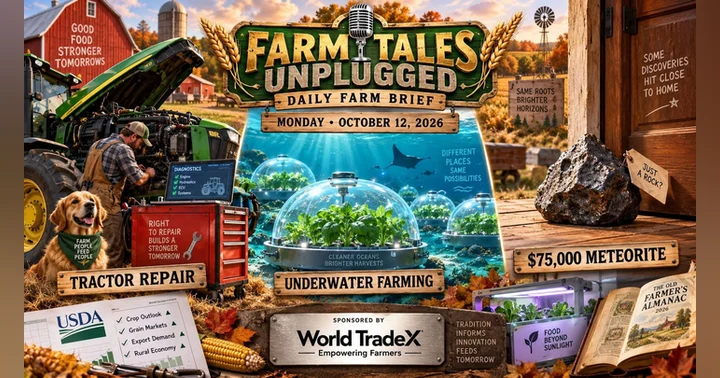
On the Monday, October 12 edition of Farm Tales Unplugged — Daily Farm Brief, Rick Portanova covers the tractor-repair debate, visits a farm beneath the Mediterranean, and explores research that could change how we think about growing food.
We start with farm equipment repair access and the FTC and USDA’s examination of repair barriers. Farmers’ complaints raise questions about access to the tools, software, and information needed to get equipment working again. We look at what officials are examining—and why the issue matters when a breakdown interrupts the work. These are concerns under investigation, not a final ruling.
Then we head underwater to Nemo’s Garden, where tending the crop involves scuba gear. This unusual project grows basil and other plants inside submerged biospheres off the Italian coast. It is an experimental approach to agriculture—and a very different kind of morning farm chore.
In Market Watch, Rick breaks down the October USDA World Agricultural Supply and Demand Estimates report, explaining what its grain-supply estimates, projected carryover, and price outlook mean in plain English.
The High-Tech Moment explores experimental research into producing food without sunlight. Scientists are investigating how acetate made using electricity, water, and carbon dioxide can support growth in darkness. We separate the intriguing research from what is ready for everyday farm use.
And then there’s David Mazurek’s Michigan meteorite: a rock used as a doorstop that ultimately sold for $75,000. Sometimes the remarkable discovery is something you have been walking past for years.
We finish with the Old Farmer’s Almanac and two surprising seasonal stories: witch hazel that launches its seeds and a wood frog that can survive being partially frozen.
Hosted by Rick Portanova. Brought to you by World TradeX — Empowering Farmers.
Start your morning with Farm Nation and Truck City. Listen, follow the show, and share this episode with somebody who appreciates the unexpected side of agriculture.
www.FarmTalesUnplugged.com Visit and bookmark Us. Follow us on all platforms.
Sponsored by World TradeX
SPEAKER_00
Good morning, Farm Nation, and hello, Truck City. This is FarmTales Unplugged Daily Farm Brief for Monday, October 12th. Brought to you by World TradeX, empowering farmers. I'm Rick Portanova. Today, your tractor quits, the crop is ready, and the rain is coming. The last thing you need is a fight over who gets to fix your own machine. Then we're heading to a farm where you need scuba gear to check the crops, and a Michigan farm where a $75,000 meteorite spent years holding the door open. We'll break down Friday's USDA report and what it means for the grain market, plus scientists trying to grow food without sunlight or even artificial light. And the old farmer's almanac gets into the strange side of fall, starting with a shrub that fires its own seeds and a frog that freezes to death then reanimates come spring. So grab your coffee, fire up whatever you're driving, and let's find out what was happening while you were busy actually working. Picture this: your crop is ready, rain is coming, and your machine quits. You've got somebody who can repair it, but getting access to the parts or software becomes another problem. That frustration is behind a new federal inquiry into farm equipment manufacturers and dealers. The Federal Trade Commission and USDA are examining complaints about repair barriers, expensive parts, and business arrangements that can limit farmers' choices. They want farmers and independent repair shops to describe what's getting in the way. Here's why that matters. The repair bill isn't necessarily the biggest bill. It's the crops sitting outside while you wait. You can postpone an appointment. You can't ask a field to stay ready until the service truck arrives. My feeling, when you buy a machine, you oughta own more than just the payments. You oughta have a fair shot at keeping it running. Now, imagine checking your crops by putting on a scuba tank. Off the coast of Nali, Italy, an experimental project called Nemo's Garden grows plants inside clear, air-filled domes anchored underwater. Basil and other herbs grow inside, the fish stay outside. The plants aren't drinking seawater, moisture evaporates and condenses inside the domes, producing fresh water for the growing system. Sunlight reaches the structures through the sea and sensors track conditions inside. This project has been developing for years. It's experimental farming, not a plan to move the corn belt offshore. But the question itself is fascinating. Could protected spaces underwater offer another way to grow certain crops where land or fresh water is limited? We're accustomed to thinking about what a farm needs overhead. These growers are investigating what might be possible beneath the surface. All right, here's the market picture. Friday's USDA supply and demand report gave corn growers more competition. More corn. USDA raised its national yield estimate to 181.2 bushels an acre, putting production at about 16 billion bushels. It also increased the corn expected to remain after the marketing year by 282 million bushels. And it cut its projected season average farm price 10 cents to $4.70 a bushel. That's a national forecast, not today's bit at your elevator. Soybean ending stocks edged higher with the price forecast unchanged. Wheat ending stocks also increased. The takeaway? USDA raised corn demand, but supplies grew even faster. That points to pressure on growers' pricing power and potentially some breathing room for feed buyers. Now for our high-tech moment. What happens when scientists ask whether a plant actually needs to see the sun? Researchers at UC Riverside and their collaborators have demonstrated a system that uses electricity, water, and carbon dioxide to make acetate, a substance that certain organisms can use as food. They've grown algae, yeast, and mushroom-producing fungi on that feedstock in darkness. They've also shown that several crop plants can use carbon from acetate. The bigger ambition is to develop crops that can grow entirely on that energy source without light reaching their leaves. That's the goal, rather than a proven replacement for conventional farming. And the electricity still has to come from somewhere. The scientific work is real. Whether it can become affordable farming is the harder question. Because a remarkable tomato still has to make financial sense to somebody growing it. Let's revisit You Don't Hear That Every Day. A rock that came with a Michigan farm eventually sold for $75,000. Before that, it was holding a door open. David Mazarick acquired the rock when he bought the property in 1988. The previous owner told him it was a meteorite, but knowing it came from space and knowing what somebody might pay for it were two different things. It really was an iron nickel meteorite weighing 22 pounds. He later sold it to Michigan State University Abrams Planetarium for $75,000. Think about that. Something that came with the farm, sat around for decades, holding a door open, and did a completely ordinary job, turned out to be an extraordinary rare meteorite. Let's finish with the old farmer's almanac and two things happening outside that sound made up. First, witch hazel. The almanac explains a common witch hazel blooms in fall and its ripening seed capsules can burst with an audible pop, throwing seeds several yards. So a shrub can be flowering and launching its seeds at the same time. And here's an even stranger cold weather survival story documented by the National Park Service. A wood frog can spend winter partially frozen with no heartbeat and no breathing. Its body produces large amounts of glucose that help protect its cells while ice forms around them. When conditions warm up, the frog thaws out and resumes activity. It hasn't died and come back, it has survived a condition that would kill most animals. I personally think it died and came back. I think they should rename it the zombie frog. Under the leaves, that little frog has a winter strategy more remarkable than anything we're putting in the equipment shed. There's a lot going on out there, even when it looks like everything is shutting down. Today, we took on the fight to fix your own tractor, visited a farm where checking the crops means strapping on a scuba tank, broke down what the USDA's latest numbers mean for the grain market. We looked at scientists trying to grow food without sun, and a Michigan farm where a $75,000 meteorite spent years holding a door open. Then we stepped into the strange side of fall with witch hazel launching seeds and a frog that comes back from the dead. And there you have it. That's your FarmTales Unplugged Daily Farm Brief for Monday, October 12th. Brought to you by World TradeX Empowering Farmers. I'm Rick Portonova, and I'll see you Tuesday morning. If you could take a moment and share this podcast with someone who might appreciate it, that would be fantastic. Thank you.