YouTube

 Apple Podcasts

 Spotify

 iHeartRadio

 Amazon Music

 Audible
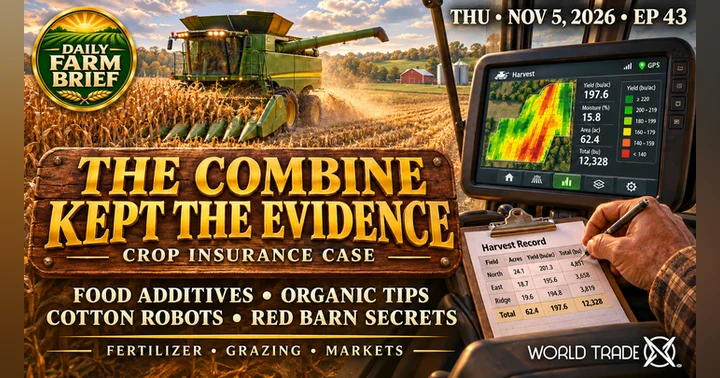
The Combine Kept the Evidence! Food Risks, Organic Tips, Robots & Red Barns — Daily Farm Brief

A crop-insurance claim said the harvest came up short. Prosecutors say the combine’s records told a different story.
Today on Daily Farm Brief, Rick Portanova follows a trail of harvest records, examines troubling ingredients that lost their place in our food supply, shares a practical organic farming tip, and explores a robot that could help rescue a patchy crop. Then we uncover the practical reason behind one of rural America’s most familiar sights: the red barn.
Thursday, November 5, 2026 • EP 43
🚜 THE COMBINE KEPT THE EVIDENCE
Two North Dakota farmers face federal charges in a crop-insurance case involving allegedly shifted grain production and harvest records that didn’t match reported yields. We explain how equipment data became part of the investigation. The charges are allegations—not convictions—and must be proven in court.
🥫 WHAT ARE WE EATING?
Artificial trans fat and brominated vegetable oil—BVO—became ingredients many consumers never thought much about. We look at why regulators acted, plus what a small NIH experiment found when participants ate ultra-processed meals. We also make an important distinction: processing alone doesn’t make a food unhealthy, and an organic label doesn’t turn a sugary snack into a health food.
🌱 ORGANIC FARMING TIPS: DON’T GROW NEXT YEAR’S WEEDS
A few weeds left to produce seed can create more work next season. Today’s quick tip focuses on catching weeds early and choosing cover crops that fit your climate and planting schedule. Practical prevention, with the supporting details on screen.
🤖 HIGH-TECH MOMENT: CAN A ROBOT RESCUE THE CROP?
When cotton comes up unevenly, empty stretches can leave farmers facing another planting decision. North Carolina State researchers are developing a system to help plant those gaps while leaving healthy plants alone. It’s still in development, and savings remain unproven—but the potential benefit is easy to understand.
🏚️ FARM FOLKLORE: WHY ARE BARNS RED?
Before red barns became a symbol of country life, farmers were thinking about protecting wood and paying for paint. Discover how practical choices became a lasting rural tradition.
PLUS: QUICK FARM HEADLINES
• Tightening fertilizer supplies from Trinidad and pressure on American farmers’ ammonia costs.
• Expanded grazing opportunities and the use of well-managed grazing to help reduce wildfire fuel.
WATCH THE BOTTOM TICKER
Expanded grain and oilseed futures, cattle and hogs, milk and cheese, other dairy products, oil and energy, national diesel and gasoline prices, farm headlines, regional weather, and moon phase—all presented visually while the stories continue.
READ OUR DETAILED MATCHING BLOG
Find the supporting facts, additional context, and sources for this episode:
https://dailyfarmbrief.com
Hosted by Rick Portanova
For Farm Nation—and Truck City.
Brought to you by World TradeX — Empowering Farmers.
Subscribe for more Daily Farm Brief, and tell us in the comments: Which farm technology has actually saved you time or money?
#DailyFarmBrief #FarmNews #OrganicFarming #FarmTechnology #Agriculture
Sponsored by World TradeX
SPEAKER_00
Farm News Headlines, just the essentials. A squeeze on fertilizer. Supplies from Trinidad are tightening, adding to American farmers' ammonia costs. And more grass for cattle, less fuel for fire. Interior is directing agencies to expand grazing opportunities and use well-managed grazing to help reduce fire risk on federal rangelands. Good morning, Farm Nation! I'm Rick Portanova, and this is your daily farm brief for Thursday, November 5th. Today, the combine that kept the evidence. Food ingredients that lost their approval, a quick organic farming tip, a robot that could rescue a patchy crop, and why barns turn red. So grab your coffee, fire up whatever you're driving, and let's find out what was happening while you were busy actually working. A crop insurance claim said the harvest came up short. Prosecutors say the Combine's records told a different story. Two North Dakota farmers now face federal charges in a case reported this week by DTN. Prosecutors alleged that grain from one farming operation was sold under another farmer's name. That made the first farm's harvest look smaller on paper and help support a claim for crop losses. But the harvesting equipment had recorded its own numbers. According to the indictment, those records showed more corn than the farmer reported to the insurance company. Investigators used that difference to help build their case. Those charges still have to be proven in court. The harvest was finished, the digital record was still there. Now, from what's harvested to what ends up in the grocery cart. The FDA estimates that removing the main source of artificial trans fat from processed foods prevents thousands of heart attacks and deaths every year. That fat raises bad cholesterol. The industrial oils supplying it were eventually pushed out of the food supply. Then there's BVO, the oil once added to some citrus drinks to keep flavoring from separating. The FDA withdrew its approval in 2024 after concluding the use was no longer safe. And the concern goes well beyond individual additives. In a small NIH experiment, people ate more and gained weight on ultra-processed foods. On minimally processed foods, they actually lost weight. Processing itself isn't automatically bad. Frozen vegetables and canned beans can be useful, nutritious foods. So where does organic fit? For farmers, it's a substantial retail market. For shoppers, the seal means certified production standards, including restrictions on pesticides and fertilizers. But that doesn't turn a sugary snack into a healthy food. Here's today's organic farming tip. Don't grow next year's weeds. A few weeds left to make seed can leave you a much bigger job next season. Pull or cultivate them while they're small. Between crops, a well-chosen cover crop can help crowd out seeds and protect the soil. The catch, it has to fit your climate and planting schedule. Start with one problem patch, keep the weeds from making seed, and plan what will cover that ground after harvest. You're doing next season's weed control before the next season even starts. A drone helps find the bare spots. The goal is for a small robot to plant fresh seed in those gaps, leaving the healthy plants alone. That could mean less wasted seed and less work repairing a poor stand. It's still in development, the savings aren't proven yet, but that's the idea worth watching. Fill the holes without starting over. Farm folklore. That old red barn owes some of its good looks to the same kind of iron compound you see in rust. Long before a paint counter could mix any color you wanted, farmers were just trying to keep wooden buildings from weathering away. Historical accounts describe homemade coatings using ingredients such as linseed oil, lime, and iron oxide. The iron pigment helped give them that familiar earthy red. Recipes varied, there wasn't one bucket that painted all of rural America. Then, commercial paint arrived, and red remained an economical choice. If you ever looked up at a red barn and wondered how many gallons it would take, you understand why that mattered. Over time, a practical color became a tradition. Today somebody sees a red barn and thinks of country life. The farmer who first painted it may have been thinking about the bill. For the extra facts behind today's stories, read our detailed matching blog at dailyfarmbrief.com. Brought to you by World TradeX Empowering Farmers. I'm Rick Portonova. Thank you for spending part of your morning with me. And we'll see you tomorrow.