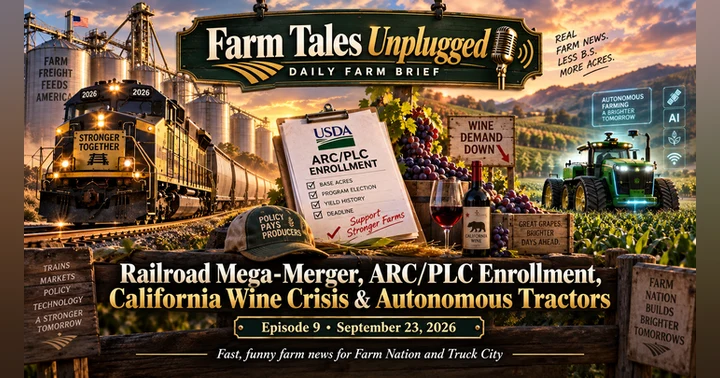
Railroad Mega-Merger, ARC/PLC Enrollment, California Wine Crisis & Autonomous Tractors | Daily Farm Brief


Farm Nation and Truck City start Wednesday with a fast, funny look at the agriculture stories that matter.
On today’s Farm Tales Unplugged — Daily Farm Brief, Rick Portanova covers the newly opened USDA ARC and PLC enrollment period, what the proposed Union Pacific–Norfolk Southern railroad merger could mean for farmers, grain transportation and agricultural freight, and why California wine-grape growers are facing a major demand problem.
Then we look toward the future of farming as John Deere pushes autonomous agriculture, artificial intelligence and precision spraying toward a world where corn production could operate with dramatically less human intervention.
Plus: the Old Farmer’s Almanac, a trip back to September 23, 1806, with Lewis and Clark, an unusual Pennsylvania apple story, and the Farmer and Trucker Jokes of the Day.
A quick morning agriculture podcast for farmers, ranchers, truckers, ag businesses and anybody interested in American farming, agricultural technology, rural America and the people who grow and move our food.
Farm Tales Unplugged is sponsored by World TradeX — The Future of Food. Empowering Farmers.
Sponsored by World TradeX
Good morning, Farm Nation, and Hello Truck City! This is FarmTale's unplugged daily farm brief for Wednesday, September 23rd. I'm Rick Bordenova. This morning, Washington is reminding farmers that sometimes the most important crop on the farm is paperwork. We've got a massive proposed railroad merger that could change the way grain moves across the country. California wine grape growers have a problem they definitely didn't order. Too many grapes and not enough people drinking wine. And John Deere is talking about a future where growing corn could be almost completely autonomous. Which means someday the tractor may be doing all the work while the farmer stands in the driveway drinking coffee and wondering why the tractor still needs financing. So grab the coffee, fire up whatever you're driving, and let's get started. We'll start with something that's not particularly exciting, but can definitely affect your wallet. USDA has opened enrollment for the 2026 Agriculture Risk Coverage and Price Loss Coverage Programs, better known as ARC and PLC. Enrollment opens September 16th and runs through December 11th. These are two major safety net programs designed to provide some financial protection when crop revenues or commodity prices fall below certain levels. And there's an important change this year. USDA says more than 30 million new base acres have been added nationally, the first major base acre expansion in about two decades. Farmers can make their election and enroll through the Farm Service Agency office or online. And even if you're thinking, I dealt with this last year, don't assume you're finished. Producers still have to enroll through a signed contract. It's paperwork. Nobody likes paperwork. But paperwork that may lead to a payment is considerably more attractive than paperwork that leads to another piece of paperwork. Now let's talk transportation. Union Pacific and Norfolk Southern are pursuing a combination that could create what the companies describe as America's first true coast-to-coast transcontinental railroad. And this matters to agriculture a lot. American farmers depend on rail to move huge volumes of corn, soybean, wheat, fertilizer, ethanol, and other agricultural products. The argument in favor of the merger is pretty simple. One connected railroad could mean fewer handoffs between railroads, potentially faster transit, and a more seamless route from farms and elevators to processors, ports, and customers. But farmers and grain shippers are asking another question: what happens to the competition? Some agricultural groups and shippers worry that additional railroad consolidation could eventually mean fewer transportation choices and less negotiating power. The Surface Transportation Board has continued reviewing the proposal after rejecting requests to throw the revised merger app out. So nothing changes tomorrow morning. But this is when farmers and especially anybody moving grain long distances should be watching. Because growing a crop is only half the battle. Eventually, you've got to get it somewhere. Out west, California grape growers are dealing with a completely different kind of supply problem. Americans simply aren't drinking as much wine. Associated Press reported this week that U.S. wine sales have fallen substantially over the past several years, leaving some California growers without buyers for their grapes. Some vineyards are being completely removed. Others are leaving grapes hanging because harvesting fruit you can't sell is basically paying somebody to help you lose money faster. And California wine grapes are not some little specialty crop. This is a massive agricultural industry with vineyards, workers, wineries, equipment companies, truckers, and entire communities built around it. The problem appears to be partly generational. Younger consumers generally aren't replacing older wine drinkers at the same rate. There's also competition from beer, spirits, cannabis, and a whole bunch of canned drinks that apparently need names, sounding like somebody made them up during a frat meeting. For growers, though, this is serious. Agriculture can handle a bad crop. Sometimes the harder problem is a good crop nobody wants to buy. Now for the high-tech minute. John Deere's CEO John May has been talking about where the company thinks autonomous farming is heading. And Deere's ambition is pretty wild. By 2030, the company wants the corn production system in the USA to be capable of operating autonomously. From tillage and planting through spraying and harvesting. Not just an autonomous tractor driving a straight line. We're talking about machines using cameras, artificial intelligence, and computer vision to make decisions in the field. Deer says it's sea and spray technology can distinguish weeds from healthy plants and target individual weeds instead of spraying the entire field. We've been covering that. May said that can reduce herbicide application dramatically. Think about where this is headed. The tractor knows where it is, the sprayer knows what's a weed, the combine knows what it's harvesting, and eventually your equipment may know considerably more about what happened in your field Tuesday than you do. The one thing I'm still waiting for, a smart tractor that looks at the weather forecast and says, Rick, forget it. Go back to bed. Now that's artificial intelligence. Time for the old farmer's almanac. Today is the first full day after the Autumn Equinox, so we are officially into fall. Days are getting shorter, nights are getting longer, and pretty soon farmers across the northern half of the country will begin that annual agricultural tradition known as why is it dark already? The old farmer's almanac has another useful little piece of wisdom for Wednesday. If you've got an old suitcase that smells musty, put a container of cat litter inside, close it for a few days, and let the litter absorb the odor, which may be excellent advice. Although if your suitcase is riding around in the sleeper of a truck, I'm not sure the suitcase is necessarily the source of the problem. This day in history, on September 23, 1806, Meriwether Lewis and William Clark returned to St. Louis after their expedition to the Pacific. They had left more than two years earlier. Their journey mapped enormous stretches of the American West and helped open a better understanding of the land, rivers, plants, animals, and transportation routes across the continent. Think about that for a minute. No GPS, no interstate, no truck stop, no buckys, no cell phone, and absolutely nobody calling every 20 minutes asking, what's your ETA? Two years on the road. Truck City? Suddenly that 11-hour driving clock doesn't seem quite so bad now, does it? And now you don't hear that every day. And here's something appropriate for Farm Nation. Apple growers in parts of Pennsylvania are having a rough fall. A severe spring freeze damaged blossoms across a number of orchards. Some growers lost most or even all of certain fruit crops. That means some farms that normally depend heavily on pick your own apples are leaning harder on fall festivals, pumpkins, hay rides, corn mazes, and other agritourism. And that is one of those reminders that modern farming sometimes means growing crops, and sometimes it means building a corn maize, selling cider donuts, and hoping somebody from Pittsburgh brings six kids. Agriculture adapts. It always has. Joke of the day. A trucker pulls into the shop and tells the mechanic, I think something's wrong with my truck. Every time I get ahead financially, the check engine light comes on. The mechanic says, That's not a malfunction, that's standard equipment. And that's your Wednesday morning daily farm brief. And to everybody in the field, heading toward the field, hauling what came out of the field, or sitting at the kitchen table trying to figure out how much that field just cost you yesterday. Thanks for starting your morning with us. Farm Nation and Truck City are two sides of the same operation because the future of food starts with the people who grow it and depends on the people who move it. I'm Rick Portonova. This is FarmTales Unplugged Daily Farm Breach. Thanks to our sponsor, World TradeX, the future of food. We'll see you tomorrow. Music, courtesy of FMA. Credits to Philip Ravenall, JMHBM, Vlad Anikov, and Sinclips.