YouTube

 Apple Podcasts

 Spotify

 iHeartRadio

 Amazon Music

 Audible
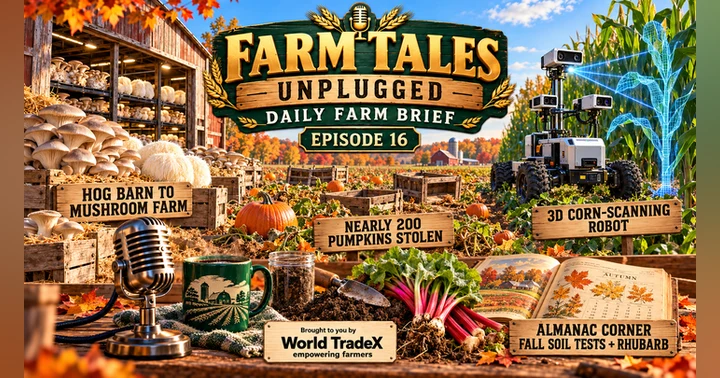
Hog Barn Becomes Mushroom Farm, Pumpkin Theft & 3D Corn Robots | Daily Farm Brief

Can an old hog barn grow a new farm business? On Farm Tales Unplugged — Daily Farm Brief for Monday, October 5, 2026, Rick Portanova explores how an Iowa family converted part of its former hog operation into a specialty mushroom farm growing oyster mushrooms and lion’s mane.
Plus, an Illinois family faces the theft of nearly 200 pumpkins from its first crop, and researchers use a camera-equipped robot to create detailed 3D models of corn plants—technology that could help plant breeders measure and compare crops.
We wrap up with practical Old Farmer’s Almanac advice on fall soil testing and planting rhubarb for future harvests.
Fresh agriculture news, unusual farm stories and emerging farm technology for farmers, ranchers, truckers and everyone who grows and moves our food.
Brought to you by World TradeX — empowering farmers.
Sponsored by World TradeX
SPEAKER_00
Good morning, Farm Nation, and Hello Truck City. This is FarmTales Unplugged Daily Farm Brief for Monday, October 5th. Brought to you by World TradeX, empowering farmers. I'm Rick Cardanova. Coming up this morning, an Iowa family has turned part of an old hog barn into a mushroom business. We'll look at how they're giving the building a second life and finding new ways to sell what they grow. Then, an Illinois family grew its first pumpkin crop only to have somebody help themselves to nearly 200 pumpkins. That's a rough introduction to the farm business. And our high-tech moment takes us inside a cornfield where researchers are using a robot to build digital three-dimensional models of individual plants. And we'll finish off with the old farmer's almanac and a little work this fall that can pay off next spring. So grab your coffee, fire up whatever you're driving, and let's find out what was happening while you were busy actually working. First up, a hog barn gets a second life. An Iowa family has given an old hog barn a completely different job. It now grows mushrooms. A report published Saturday revisited the story of 1100 Farm. That's 1100 Farm in Radcliffe, Iowa. The Faudborg family once raised around 8,000 hogs a year. After leaving that business, they began testing whether the buildings could support specialty mushroom production. This summer, they finished converting half of a 200-foot hog barn into growing and processing space. Inside are rooms for growing mushrooms, space to prepare the material they grow on, and a kitchen for turning the harvest into products. Their crops include oyster mushrooms and lion's mane, the shaggy-looking variety that almost looks like it needs a haircut. And here's the business angle. They're developing several ways to sell what they grow. Alongside mushroom production, the family sells flavored salts, coffee blends, and hot chocolate blends. They also make their own growing blocks using soy hulls and hardwood pellets. The farm became a demonstration site in July for the Transformation Project, the nonprofit program helping with the conversion. That support matters. This took planning, construction, and outside funding. The project is collecting information on cost, labor, and product margins so other farmers can see what the change actually involves. For me, the interesting question is what an existing farm building might be capable of doing next. A barn represents years of work and a substantial investment. Giving it another productive use can be a powerful idea, provided the buyers are there and the numbers work. That's what makes this worth following. The family has moved beyond a small growing experiment and into the harder job of building a repeatable business. Same farm, familiar buildings, a very different harvest. Story number two somebody harvested the pumpkins without buying them. Now to Capron, Illinois, northwest of Chicago. ABC 7 reported Saturday that nearly 200 pumpkins were stolen from the Myers family farm, according to the owners. Vicky and Tyler Myers had planted pumpkins for the first time this season. Their plan was to welcome families out to pick a pumpkin and enjoy the farm. Instead, they're planning to add security cameras. They told the station they hope to remain open through much of October selling the other produce they grew. I hope they do. A first season ought to give a family a chance to find out whether the customers enjoy what they've built. And if you're in the Chicago area, give them some support. I think they could use it. There's a particular frustration here for anyone who grows something to sell. The work happens long before the customer arrives. You put time and money into the crop and you plan around the chance to sell it. Losing it near the finish line takes away that opportunity. And nearly 200 pumpkins is a lot of somebody else's work to carry off. So again, for listeners near Capron, the report offers a simple way to follow the story. Check whether the farm is open and see what the family still has for sale. A paying customer would be a welcome change. And again, that's Myers Family Farm, Capron, Illinois. Time for the high-tech moment, a digital copy of the cornfield. Now, picture a robot moving through standing corn and turning the plants around it into three-dimensional digital models. A study made available online October 1st in the journal Artificial Intelligence in Agriculture describes a ground vehicle system using several synchronized cameras that capture both pictures and depth information. The researchers combine those views to reconstruct the crop in three dimensions. Separate individual plants and estimate traits such as plant height and stem thickness. That's the basic idea behind a word you'll hear more often: phenotyping, measuring what a plant actually looks like and how it grows. Think about the difference between photographing a room from the doorway and walking around it. The second view gives you much more information about what's inside. For a corn plant, having more than one camera angle helps the system deal with overlapping leaves and obstructed views. The research reported plant counting accuracy of about 94.5% under the field conditions tested. It's a research result and it belongs in that context. This is not a machine I'm telling you to order for next week's harvest. But imagine the breeding questions a tool like this could help answer. Which plants have the structure you want? How do two varieties compare when you measure more than a few representative plants? Where does the crop become uneven? My interest is in what better measurement could make possible. A breeder still has to decide which traits matter and test whether the next variety performs. The machine helps collect the evidence. And that's a useful direction for farm technology. Give the people making the decisions a better view of what's happening in the field. And as we wind down, the old farmer's almanac calls fall a good time to test garden soil. The appeal is simple. You have to understand the results and plan improvements before the spring planting rush. Contact your local extension office for sampling instructions and information about testing. A useful sample starts with following the lab's directions. And here's the fall job with one more traditional reward: rhubarb. The almanac says established rhubarb can be divided when dormant in late fall or early spring. New crowns can be planted in late fall after dormancy begins. Pay attention to the plant in your local conditions, of course. October 5th doesn't mean every garden in the country is ready for the same job. Rhubarb needs good drainage and does best with cool winters and relatively cool summers. Give it space and give new plants time to establish. The almanac recommends leaving the first growing season stalks unharvested. That takes some patience. But a healthy rhubarb patch can remain productive for 10 years or more. There's something satisfying about planting food that becomes part of the place. The garden comes back, the season comes around, and somebody starts talking about pie. And there you have it, that's your Farm Tales Unplugged Daily Farm Brief for Monday, October 5th. I'm Rick Portonova, and we'll see you Tuesday morning. And if you enjoyed this podcast, please give us a share, a like, a review.