
 YouTube

 Apple Podcasts

 Spotify

 iHeartRadio

 Amazon Music

 Audible
History of Barb wire, Satellite Images of Crops M-net, Beavers Store Winter Food
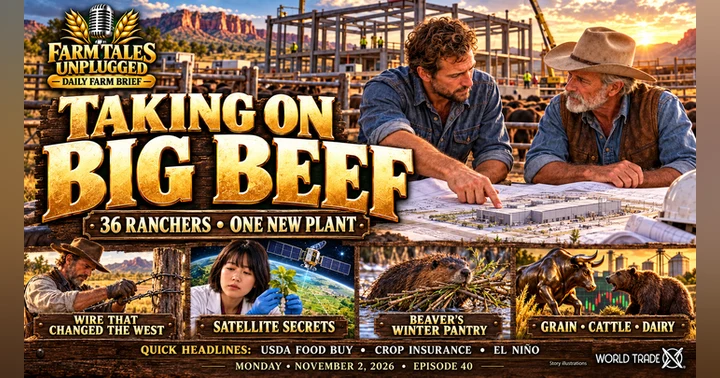
Thirty-six cattle producers want another buyer—and they’re backing a new Texas beef plant to help create one. Could this project give ranchers another dependable place to sell?
In the Monday, November 2, 2026 edition of Farm Tales Unplugged — Daily Farm Brief, Rick Portanova looks at the planned Dimmitt, Texas facility, the federal loan guarantee supporting it, and what another bidder could mean for local cattle producers. The plant is planned, with processing capacity and jobs still projections.
Then, the little twist of wire that changed the West: how Joseph Glidden’s barbed-wire improvement helped protect crops, close the open range and spark conflicts over access to land and water.
In High-Tech Moment, researchers find useful soybean-yield clues in satellite viewing angles that were once treated as a problem to correct. Sometimes the sharper picture isn’t the whole story.
The Old Farmer’s Almanac takes us beneath the ice to a beaver’s winter pantry—and explains why those branches beside the lodge may be dinner.
Quick headlines cover USDA’s planned food purchases, crop-insurance harvest prices and an El Niño outlook for the central and southern Plains. We finish with grain, cattle and dairy futures, using Friday, October 30’s reported closing prices.
More information and the matching episode blog: https://farmtalesunplugged.com
Brought to you by World TradeX — Empowering Farmers.
Farm Nation and Truck City: follow, like and share the show, and we’ll see you tomorrow morning.
Sponsored by World TradeX
SPEAKER_00
Farm News Headlines. USDA plans to buy up $472.5 million in American grown food for nutrition programs. DTN reports crop insurance harvest prices of $4.75 for corn, $12.63 for soybeans per bushel. And El Nino raises the odds of a wetter winter across the central and southern plains. Those are the quick headlines, now today's main stories. Good morning, Farm Nation, and Hello Truck City. This is FarmTale's unplugged daily farm brief for Monday, November 2nd. I'm Rick Portanova. 36 cattle producers want another place to sell their cattle, so they're behind a new Texas beef plant. Then the little twist of wire that helped end the open range, a surprising clue satellites nearly threw away, and a beavers grocery store beneath the ice. We'll finish with grain cattle and dairy markets. And if you enjoy the show, would you give us a follow, a like, or a share? So grab your coffee, fire up whatever you're driving, and let's find out what was happening while you were busy actually working. Farm News ranchers want another buyer. If you want more competition for your cattle, here's one way to pursue it. Help build another packing plant. In Dimmitt, Texas, 36 local investors involved in raising cattle started a project to do exactly that. USDA announced Thursday that its rural business loan guarantee program is supporting a $24.6 million commercial loan for the new facility. The planned plant would process about 400 cattle a day and is expected to create 220 jobs. Their goal is another option alongside the big national meat processors and more competition for the cattle they raise. That's the part the ranchers will be watching. Does another plant bring another dependable bidder? The announcement supports construction. It doesn't mean the plant is already running, and it doesn't guarantee higher cattle prices. But it gives us something specific to follow. Local cattle producers trying to build the buyer they want to have. Farm history. Before electric fences and virtual fences, a little twist of wire helped turn neighbors into enemies. On the Great Plains, lumber could be scarce and expensive. Growing a hedge took years. Keeping roaming cattle out of a crop was a serious problem. Then came barbed wire. Joseph Glidden, an Illinois farmer, didn't invent the first version. His 1874 improvement helped solve a stubborn problem, though, keeping the barbs locked in place on a double strand of wire. He also developed machinery to make it in quantity. Now farmers could fence land more cheaply and quickly. Cattle stayed out of crops, boundaries became harder to ignore. But fences also cut across land and water herders had been using. Conflicts over access helped fuel range wars, indigenous people faced another barrier crossing lands they had long depended on. The same wire that protected one person's crop could block another person's route to water. Look at an old fence line, and you're looking at more than a rusty line. You're looking at a technology that changed who could go where and who controlled the land. Here's your high-tech moment. Take two pictures of the same soybean field from different angles, and the field can look different. For satellite researchers, that difference has often been something to correct. A research team asked, what if it's telling us something useful? They built a system called MNET that uses those changing views to learn about the crop's leafy structure. It also uses a faint light signal associated with photosynthesis, the process plants use to turn sunlight into energy. Together, those clues helped estimate soybean yields across 613 U.S. counties. Here's the surprise. In their test, information from several angles could be more useful than simply having a sharper picture from one angle. The study used earlier growing seasons with a separate year held back to test the system. It's research into regional field estimates, not a promise of an exact harvest forecast for your farm. Sometimes a better answer starts with the information you are about to throw away. Let's open the old farmer's almanac. A beaver can have winter groceries waiting outside its front door, even when that door is underwater. The old farmer's almanac calls November's full moon the beaver moon, linking the name to the old trapping season before waterways froze. In cold regions, beavers store branches and stems underwater near their lodge or bank den. When ice covers the pond, that food remains within swimming distance of their entrance. And despite that fishing pond access, fish aren't on the menu. Beavers eat plants, including bark and the soft inner layers of woody stems. Their teeth keep growing, while chewing wears them down. The front surface wears more slowly than the back, helping maintain a cutting edge. So the animal hauling a branch into the water may be stalking the pantry rather than adding another room to the house. And that pile of sticks beside the lodge, some of it may be dinner. Market Watch. Here are Friday's closing futures numbers for October 13th, as reported by Farms.com. December corn, $4.47 and three quarter cents a bushel down three and a half cents. January soybeans, $12.34.25 a bushel down half a cent. December Chicago wheat, $6.3.5 a bushel down a quarter of a cent. December live cattle, $220.95 per 100 weight, down $5.35. January feeder cattle, about $331.78 per hundredweight, down about $10.18. And December Class 3 milk, $16.74 per hundredweight, down five cents. And if you'd like more information about any of the topics we've covered, there's an expanded matching blog for every episode we release. You'll find it on our website, farmtailsunplugged.com. And there you have it, that's your FarmTales Unplugged daily farm free for Monday, November 2nd. Brought to you by World TradeX Empowering Farmers. I'm Rick Portanova, and I'll see you tomorrow morning.