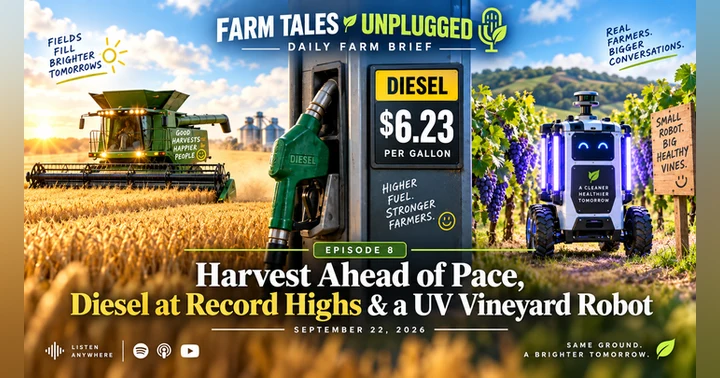
Harvest Ahead of Pace, Diesel at Record Highs & a UV Vineyard Robot | Daily Farm Brief


Corn and soybean harvest are running ahead of the five-year average, winter wheat planting is lagging, and cattle futures surged after a surprisingly tight Cattle on Feed report.
On today’s Farm Tales Unplugged — Daily Farm Brief, Rick Portanova breaks down the latest grain and livestock markets, updated USDA harvest and planting progress, and what falling crude oil prices could mean for farmers and truckers still paying record-high diesel prices.
We also look at California wine grape growers struggling with weaker demand, rising custom harvest costs, tighter dairy margins, and the changing protein and butterfat needs of the U.S. dairy industry.
Then we head into the vineyard after dark, where autonomous Thorvald robots are using ultraviolet light to fight powdery mildew — although apparently even a $125,000 farm robot can still lose a fight with a gopher hole.
Plus: the Farmer’s Almanac, the arrival of astronomical fall, the Harvest Moon, This Day in Farm History, cattle prices, and the Farmer Joke of the Day.
Farm Nation, Truck City — grab the coffee and fire up whatever you’re driving.
Farm Tales Unplugged — The Daily Farm Brief.
Sponsored by World TradeX — The Future of Food.
Sponsored by World TradeX
Good morning, Farm Nation, and good afternoon to Truck City. This is FarmTales Unplugged Daily Farm Brief for Tuesday, September 22nd. Brought to you by World TradeX, the future of food. I'm Rick Cordonova. This morning, combines are moving faster than normal. Wheat planting is moving slower than normal. Cattle futures took off like somebody left the gate open. Oil is finally coming down, but unfortunately nobody has bothered to tell the diesel pump yet. Also, we've got a robot roaming California vineyards at night, shooting fungus with ultraviolet light, which sounds less like farming and more like something you'd see after midnight on the History Channel. So grab your coffee, fire up whatever you're driving, and let's get started. Quick market watch. Let's start with the board. Monday finished with a strong move higher across the major grain contracts. December corn closed at 5.43 a bushel, up 15.5 cents. November soybeans closed at 13.28 up 24.5 cents. And December Chicago wheat finished at 7.26 up 12.5 cents. While Minneapolis December wheat finished near 7.46 and a quarter. This morning, however, the tone is softened. Wheat came under pressure overnight as Russia explored additional Baltic and Arctic routes for moving grain outside traditional Black Sea channels. That matters because anything suggesting more Russian wheat can reach world buyers tends to put pressure on wheat prices. Corn and soybean export inspections both strengthened last week, which provides some underlying support, even as harvest supplies hit the market. So the short version this morning? Yesterday, corn up, beans up, wheat up. This morning, the market took one look at all that optimism and said, All right, everybody settle down. Now let's see what's actually happening in the field. USDA released its newest crop progress reports yesterday afternoon. Corn, corn harvest is now 13% complete nationwide. That's up 8% a week earlier and ahead of the five-year average at 11%. About 58% of the crop is mature compared with the five-year average of roughly 55%. USDA currently rates 57% of the corn crop good to excellent. So combines are moving, and nationally they're moving just a little faster than usual. Soybean harvest is moving even faster. 12% of U.S. soybeans are now harvested. The five-year average is only about 8% at this point. About 62% of the crop is dropping leaves versus roughly 58% normally. So soybean condition is currently around 58% good to excellent. So soybeans are running roughly four percentage points ahead of the normal harvest pace, which means there are a lot of combines running and a lot of farmers promising their families I'll be home for dinner. Winter wheat planting, meanwhile, is lagging behind normal. Only about 17% of the crop has been planted compared to a five-year average of roughly 21%. About 2% has emerged versus about 4% normally. So today's scorecard is pretty simple. Corn harvest ahead. Soybean harvest, well ahead. Winter wheat planting, behind. And spring wheat harvest is essentially wrapped up with about 96% harvested, right around normal for this point in September. Finally, a little good news. Let's talk fuel. Because farmers and truckers have been watching the diesel pump lately like a slot machine that only takes money. Here's the encouraging part. Crude oil prices dropped to a two-week low this morning. Brent crude was around $98.23 a barrel. The more actively traded November West Texas intermediate contract was around $90 a barrel this morning. That's considerably better than the 110 Brent crude we saw last week. Why the improvement? There are a couple of recent developments. Saudi Arabia has restarted its east-west oil pipeline after it was shut down following drone attacks, and exports through the Red Sea port of Yanbu could resume. At the same time, Iran has indicated that the Strait of Hermuz could potentially reopen within seven days if diplomatic conditions improve. And Saudi Aramco has already increased crude shipments through Hermuz. All of that gives the market some hope that more oil can get where it needs to go. Now here's the bad part. Diesel hasn't gotten the memo. Triple A's national average for diesel this morning is approximately $653 a gallon. That's a new record. Yesterday it was about $651. A week ago, $627. One year ago, $369. So we're looking at nearly $3 more per gallon than this time last year. The problem is that crude oil and diesel are not the same market. Refined diesel supplies remain exceptionally tight. US refineries have been operating extremely hard, while refinery disruptions and reduced exports from Russia and the Middle East have squeezed world supplies. So today's situation is basically oil improving, diesel still ugly. There is finally a path towards relief if crude supplies continue normalizing and refined product availability improves. But I would not expect the diesel pump to suddenly become friendly this afternoon. Apparently, it needs some time to process its feelings. Here's a surprisingly serious agriculture story out of California. Wine grape growers are struggling to find buyers. U.S. wine sales have dropped about 23% over the past five years, and total spending on wine has fallen roughly 22%. The result? Some growers are leaving grapes hanging, selling below production cost, or ripping vineyards out altogether. About one quarter of California vineyard acreage has reportedly been removed from production as the industry attempts to rebalance supply with weaker demand. That's a huge change for a business that spent decades expanding, and it demonstrates something farmers already know better than almost anyone. You can grow a beautiful crop, you can have excellent weather, you can do everything right. And if the customer isn't buying, you still have a problem. Some growers are now trying to decide what comes next for land that has produced wine grapes for generations. All right, technology moment, and this one is exactly the kind of farm technology story we love here at FarmTales Unplugged. California Vineyards are testing a self-driving machine called Thorvald. Thorvald weighs about 900 pounds. It quietly drives through the vineyard rows at night and blasts grapevines with ultraviolet light. Why? To kill powdery mildew. No conventional fungicide required. More than a hundred of these robots are already working in 27 California vineyards, and developers expect them to treat about 2,600 acres this year. But here's my favorite part. During testing, one of the robots got stuck in a golfer hole and it kept its ultraviolet lights running. It reportedly fried three grapevines. Engineers have since improved the machine. Note it doesn't say fixed. But somewhere there's a golfer sitting underground saying, You're welcome. The newest Thorvald is expected to cost around $125,000. So agriculture has officially reached the point where your newest employee can work all night, doesn't need health insurance, kills fungus with ultraviolet radiation, and can still get defeated by a golfer. That's technology. And here's a quick one for the dairy farmers. Dairy farmers are facing tighter margins again as feed prices rise and milk remains under pressure. A report published this morning says daily margin coverage payments could potentially return for September, October, and November if margins continue tightening. Front month class three futures most recently closed around 1616 per hundred weight. Another issue worth watching is what's actually inside the milk. Over the past decade, U.S. dairy farmers have done an incredible job increasing butter fat. Butter fat content increased from about 3.75% to 4.32% between 2015 and 2025, but protein hasn't increased as quickly. That's becoming important because nearly half of U.S. milk goes into cheese production and cheesemakers increasingly need protein. So Dairy's next challenge may not simply be make more milk. It may be make the milk with exactly what the cheese guy wants in it, which proves once again that even a cow can apparently get performance reviews. Cattle check. Cattle had a very strong Monday. The latest cattle on feed numbers showed August placements running 9.2% below last year and about 6.5% below what traders expected. That suggests tighter supplies lie ahead. Live cattle futures finish Monday, an average of about $5 higher. Feeder cattle futures jumped an average of more than $8. Cattle supplies are already tight. So Monday's market basically looked at the USDA report and said, we're gonna need more cows. From the Farmers Almanac, today is the first day of astronomical fall. The Autumnal Equinox arrives tonight, September 22nd. And despite the name Equinox, day and night aren't actually 12 hours long because of atmospheric refraction and the way sunrise and sunset are measured. The Farmers Almanac gardening calendar calls September 22nd a poor planting day and traditionally recommends using the day for controlling plant pests instead. And we're heading towards the harvest moon on September 26th, so fall officially starts tonight, which means somewhere in America, somebody will celebrate by ordering a pumpkin spice latte while a farmer looks at the calendar and says, that's nice, we've got 1,400 acres left. This day in history, September 22nd, 1952. Here's one I had never heard before. On this day, in 1952, inventor Kenneth Caldwell filed a U.S. patent application for an improved tractor-mounted stone picker. The machine used a rake attached to a tractor linkage to collect rocks and dump them into a carrying box. In other words, somebody finally looked at a field of rocks and thought, there's gotta be a better way than sending the kids out there. The patent was eventually issued in 1955, and anyone who's ever picked up rocks by hand can agree. Mr. Codwell deserves a medal, not a patent. Now, before we get out of here, here's your farmer joke. An old farmer is standing by his fence when a slick young man in a fancy suit and a brand new sports car pulls up. Young man rolls down his window and says, Old man, if I can guess exactly how many sheep you have in this pasture, will you let me keep one? Farmer looks at his massive flock, shrugs, and says, Sure, why not? The young man whips out his smartphone, hooks it up to a satellite drone, runs an algorithm, and prints out a 50-page report on a portable printer. He turns to the farmer and says, You have exactly 347 sheep. Farmer nods, Wow, that's correct. Go ahead and take your pick. The young man smiles, grabs one of the animals, and stuffs it into the back of his sports car. As he's about to drive away, the farmer says, Hold on. If I can guess exactly what your profession is, will you give it back? Young man laughs. Go ahead, try me. Farmer says, You're a corporate consultant. The young man's jaw drops. Amazing! How could you possibly know that? The farmer replies, Well, it's pretty simple. You showed up here without being invited, you charged me a fee to tell me something I already knew, and you clearly don't know anything about my business because you just put my sheepdog in your back seat. And that's your FarmTales Unplugged daily farm brief for Tuesday, September 22nd. I'm Rick Portonova. We'll see you tomorrow. Music courtesy of FMA credits to Philip Ravenal, JMHBM, Vlad Anikov, and Sincleps.