YouTube

 Apple Podcasts

 Spotify

 iHeartRadio

 Amazon Music

 Audible
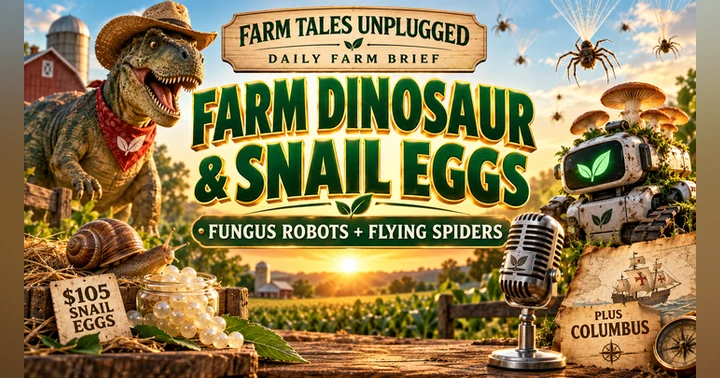
Farm Dinosaur, $105 Snail Eggs & Fungus Robots—Plus Columbus | Daily Farm Brief

A dinosaur on the farm. A tiny jar of snail eggs with a $105 price tag. Robots controlled by living fungus. And spiders that take to the sky without wings. This is not your ordinary day in agriculture.
Join Rick Portanova on Farm Tales Unplugged — Daily Farm Brief for a trip through the stranger side of farming, science, and the natural world.
Meet the Australian farm family behind the discovery of “Cooper,” a massive prehistoric dinosaur, then step into the unusual world of snail caviar, where Peconic Escargot’s 50-gram jar carries a $105 price tag. We also take a quick look at the grain markets before heading into Cornell’s research on fungus-controlled robots—where signals from a living organism help machines move.
In the Old Farmer’s Almanac segment, we explore “flying” spiders and the remarkable role of silk and electric fields in helping them become airborne. No wings required.
Then we turn to Columbus and the Columbian Exchange—how corn, potatoes, and tomatoes spread overseas while wheat, cattle, pigs, and horses came to the Americas. It reshaped farming and food around the world, but the history also includes the devastating disease and displacement experienced by Indigenous communities.
Big discoveries, unusual farm products, surprising technology, and the history behind what we grow and eat.
Find the matching episode blog at FarmTalesUnplugged.com for more information about the topics covered. Follow the show, give us a like, and share it with someone who keeps us fed—or keeps it moving.
Brought to you by World TradeX — Empowering Farmers.
Sponsored by World TradeX
Good morning, Farm Nation, and Hello Truck City. This is FarmTale's unplugged daily farm brief for Tuesday, October 13th. Brought to you by World TradeX empowering farmers. I'm Rick Portanova. Today, a teenager goes out to help round up livestock. His family ends up uncovering a dinosaur nearly a hundred feet long. Then we're heading to a New York farm where a little jar of snail eggs carries a $105 price tag. We'll check the grain markets, then wait until you hear what scientists let control a robot. And they grew it. And we'll finish with something you might see floating across your pasture this fall. There could be a spider riding it and electricity helping it fly. And if you enjoy our show, give us a follow, a like, or a share. That would be fantastic. So grab your coffee, fire up whatever you're driving, and let's find out what was happening while you were busy actually working. Imagine finding out your livestock had been walking over the remains of an animal almost as long as a basketball court. That's the scale of this story from the Mackenzie family's property in Queensland, Australia. It started back in 2004. 14-year-old Sandy McKenzie spotted an unusual rock while helping round up livestock. That sent the family looking for more. Two years later, his parents, Stuart and Robin, discovered the dinosaur nicknamed Cooper. The museum estimates this giant plant eater stretched close to 100 feet long. Its hips alone stood more than 20 feet off the ground. These bones are 95 million years old. Picture trying to explain the discovery when somebody asked you how things are going at the farm. But the family's story kept growing. The discoveries helped lead to the Ural Magna Natural History Museum, where those remarkable fossils could be studied and shared. A teenager stopped to look at a rock. His family helped open a window into an entire prehistoric world. Now, from something enormous to a farm product you could carry in one hand. A little jar, less than two ounces, $105. Inside, snail eggs. Taylor Knapp runs Peconic Escargo on New York's Long Island. He started as a chef who wanted fresh local snails for a restaurant dish. He couldn't find the supply he wanted. A former chef suggested raising them himself. That suggestion became a business. Today the farm raises snails in a greenhouse in Kuchog. They eat greens such as clover and dandelion. Before processing, they get herbs including basil, mint, and tarragon. I guess to make them taste better. So even the menu for the livestock, livestock being snails, sounds like something right out of a restaurant. And alongside the escargot, there's snail caviar. The farm's online shop lists a 50-gram jar at $105. A chef needed one ingredient. He ended up building a farm that sells the snails. And the next generation of snails, one little jar at a time. A quick market check. Monday morning, corn and wheat were higher while soybeans slipped. Traders were still working through Friday's USDA supply report. The pressure on beans carried into the new week. And now the high-tech moment. Living fungus controls a robot. Researchers at Cornell grew living fungus into its electronics. And signals from that fungus help make the machine move. But let that sink in. They grew part of the control system. The work reported in 2024 used mycelium, the fine branching threads that make up the growing body of the fungus. Those threads produced tiny electrical signals. The researchers built equipment that read those signals and turned them into commands for a robot. They tested two machines, one walked, one rolled. Then they shone ultraviolet light on the system. The fungus responded, and the robots changed how they moved. Here's the farming connection. The researchers hope that future versions could sense soil conditions and help determine when crops need fertilizer. They have shown that living fungal tissue can respond to its surroundings, and that response can help control a machine. And now a belated day in farm history. Yesterday was Columbus Day, and here's the part of that history you can still see in a farm field. By the way, he got to the Americas on Sunday, but he had to drop anchor because holidays only come on Mondays. Back to the story. Before 1492, there were no cattle ranches in Texas, and nobody in Ireland was digging potatoes. Columbus reached the Caribbean on October 12, 1492. A Monday, I think. The voyages and colonization that followed opened an enormous exchange of crops and livestock across the Atlantic. Corn, potatoes, and tomatoes developed by indigenous farmers in the Americas spread overseas. Wheat, cattle, pigs, and horses came to the Americas. Historians call it the Columbian Exchange. It changed farming and food around the world. That history sadly also brought devastating disease and displacement to Native communities. So when you see a wheat field, a herd of cattle, or a truck hauling potatoes, you're seeing part of a story that crossed oceans and reshaped what the world grows and eats. Now let's step outside for the old farmer's almanac. October has plenty of plastic spiders hanging from porches. The real ones have a trick that's hard to believe. They can leave the ground and travel through the air. If you've noticed fine threads drifting across a field in the fall, you may have seen part of that journey. Young spiders release silk that catches air currents. It's called ballooning. A tiny spider climbs to a launch point, lets out silk, and can be carried away to a new home. But here's the wild part: electricity can help provide the lift. University of Bristol researchers put spiders in carefully controlled electric fields. They use field strengths found in the atmosphere. The spiders could become airborne even without moving air. Switch the field on and the spider could rise. Switch it off and it could come down. Wind still matters outdoors, scientists are studying how those forces work together. So when the low autumn sun lights up those drifting strands, you're looking at something more interesting than just a few loose cobwebs. You may be watching a tiny traveler's way out into the world. And if silk collects along the garden fence, there's usually no reason to reach for a spray. Spiders eat plenty of insects that damage plants. Brush a strand away from the doorway if it bothers you. Out in the garden, give those little hunters some room. So today, a farm family uncovered a prehistoric giant. A Long Island chef turned snail farming into a business with a $105 jar of eggs, snail eggs, corn and wheat started Monday higher while beans stayed under pressure. Living fungus helped control robots, and a tiny spider showed us that even the air above a pasture holds a few surprises. And if you'd like more information about any of the topics we cover on our show, there's a matching blog for every episode we release. You'll find it on our website, farmtailsunplugged.com. To farm nation, have a safe and productive day. To Truck City, keep the shiny site up. The future of food starts with the people who grow it and depends on the people who move it. And there you have it. That's your FarmTales Unplugged daily farm brief for Tuesday, October 13th. Brought to you by World Trade X, empowering farmers. I'm Rick Portonova, and I'll see you Wednesday morning.