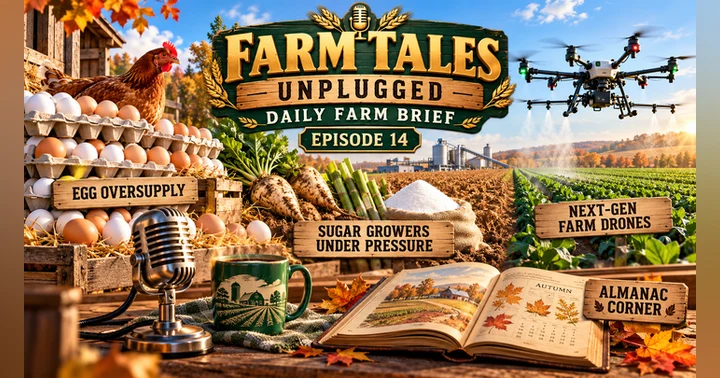
Egg Prices Crash, U.S. Sugar Growers Struggle & Farm Drones Go Autonomous | Daily Farm Brief



Egg prices are plunging as U.S. production rebounds, American sugar growers face drought, pests and rising imports, and the newest agricultural drones can spray, refill and return to work almost entirely on their own. Rick Portanova covers the biggest farm stories of the day, plus practical fall advice from the Old Farmer’s Almanac, on the September 30 edition of Farm Tales Unplugged — Daily Farm Brief.
Sponsored by World TradeX
Good morning, Farm Nation, and good afternoon, Truck City. This is FarmTales Unplugged Daily Farm Brief for Wednesday, September 30th. I'm Rick Portanova. I'll start off by saying that soybeans continue to be a bigger problem and there are more developments, and I'm sure you've heard it everywhere else. So we're gonna leave soybeans out of this episode. But with our show, remember when everybody was complaining there weren't enough eggs? Well, agriculture has managed to swing the pendulum completely the other direction. We've also got sugar growers dealing with drought, pest, and a flood of imported sugar. And wait until you hear what the newest generation of agricultural drones can do. Some of these things are starting to look less like farm equipment and more like something that should have its own flight number. And then we'll finish up with the old farmer's almanac. So grab your coffee, fire up whatever you're driving, and let's find out what was happening while you were busy actually working. First up, from egg shortage to too many eggs. What a difference a year makes. Not long ago, Bird Fluid wiped out millions of laying hens. Egg shells were thin, prices went through the roof, and people were standing in the grocery aisle staring at a dozen eggs like they were considering financing options. Now the problem is flipped. Calmane Foods, the largest egg producer in the United States, reported its latest quarterly results this morning, and the numbers tell the story. The company says the average selling price for its conventional eggs dropped more than 59% compared to a year ago. Why? The national laying flock has been rebuilt, egg production has recovered, and suddenly the market has plenty of supplies. CalMaine recorded a $58.6 million quarterly loss. A year earlier, it made nearly $200 million in profit. Same business, same product, completely different market. Demand for eggs hasn't disappeared. This is mainly a supply story. Producers rebuilt flocks after the bird flu losses, production came roaring back, and the shortage became an oversupply. Great news if you're buying breakfast. A lot less exciting if you're the one producing breakfast. And it's another perfect example of what makes agriculture such a strange business. Everybody tells you to produce more when prices are high. Then everybody produces more, and suddenly everybody wonders what happened to the price. Story number two: America's sugar growers are getting squeezed. The U.S. sugar crop has its own set of problems this fall. Sugar beet acreage is projected at roughly 1.01 million harvested acres this year, the third lowest level in about 45 years. Nearly 60% of U.S. sugar beet production was recently located in areas experiencing drought. Meanwhile, growers in Florida have been dealing not only with dry conditions, but also an infestation of pasture mealybug affecting sugar cane. So you'd think tighter domestic production would mean higher prices for American growers. Not necessarily. The United States is also expected to bring in substantially more imported sugar. Imports for the new fiscal year are projected around 3.58 million short tons raw value, roughly 26% higher than the revised estimate for the previous year. And when inexpensive world sugar keeps entering the market, it can hold down domestic prices, even while American growers are paying more for labor, fuel, fertilizer, and everything else required to produce the crop. So you've got fewer beet acres, drought pressure, bugs attacking cane, and potentially plenty of sugar anyway. Agriculture has a remarkable ability to make both shortage and abundance expensive. Time for the high-tech moment. Now for something considerably more fun. The next generation of agricultural drones is getting seriously capable. Some of the newest machines being introduced for farm use are carrying up to 40 gallons of product. One new model is rated to cover roughly 95 to 110 acres per hour. Another is designed for fully autonomous operation with onboard decision making. And some systems are now claiming the ability to work across more than a thousand acres in one day. But the drone itself is only half the story. Companies are now building automated ground stations that can refill the spray tank and even change batteries without somebody standing there waiting for the drone to come back. So imagine this drone goes out, sprays the field, comes back, gets refilled, gets another battery, and heads back to work. Meanwhile, you're somewhere else doing one of the other 47 jobs waiting for you. There are also new scouting systems moving through the fields, photographing plants at speed and identifying weeds, rocks, and stand counts. Agricultural aviation used to mean a pilot in an airplane flying 20 feet off the ground. Increasingly, it may mean a machine quietly leaving a trailer, doing its job, and coming home by itself. That's not 20 years from now. That's equipment being marketed to agriculture right now. And as we wind down, let's visit the old farmer's almanac. As perennial plants begin fading away for the year, the almanac recommends marking their locations with small sticks. It's really simple, but there's a good reason. By early spring, everything looks different, and it's surprisingly easy to cultivate right through the exact plant you spent all last summer trying to keep alive. Today's almanac calendar also says that this is considered a good day for harvesting below ground crops. And here's a little almanac wisdom that might save you some money next spring. If you're absolutely positive you'll remember where that plant is, put the stick there anyway. That isn't a dad joke, that's experience. And that'll do it for this Wednesday's edition of FarmTale's Unplugged Daily Farm Brief. This morning, we watched the egg business go from shortage to oversupply almost overnight, looked at the squeeze facing America's sugar growers, and checked out agricultural drones that can spray, refill, and head right back to work with less human intervention than ever before. And the old Farmers Almanac reminded us that sometimes the smartest piece of agricultural technology available is still a stick in the ground. To everybody in Farm Nation, keep doing the work that keeps the country fed. To everybody in Truck City, keep it safe out there and keep America moving. The future of food starts with the people who grow it and depends on the people who move it. I'm Rick Portanova, and this is FarmTale's unplugged daily farm brief.