China Farm Tariffs, Soybeans, Beef Labor & Harvest Progress | Daily Farm Brief – Sept. 29, 2026


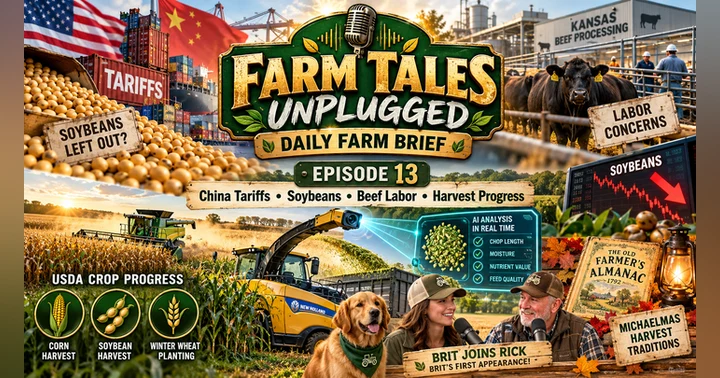
China is cutting tariffs on a broad range of U.S. agricultural products — but American soybeans are being left out. On today’s Farm Tales Unplugged — Daily Farm Brief, Rick Portanova breaks down what the latest U.S.-China agriculture trade developments could mean for farmers and soybean growers.
We also look at labor concerns affecting Kansas beef processing and the U.S. cattle supply chain, plus the latest USDA crop progress numbers for corn harvest, soybean harvest and winter wheat planting.
Then we head into ag technology, where new camera and sensor systems are helping farm equipment analyze crops as they move through the machine.
And joining Rick for the first time is Brit, who brings us today’s Old Farmer’s Almanac stop with the history and agricultural traditions surrounding Michaelmas.
In this episode:
• U.S.-China agricultural tariffs and soybean trade
• Kansas beef-processing labor concerns
• USDA corn and soybean harvest progress
• Winter wheat planting update
• Agricultural markets and crop conditions
• New Holland farm technology and ForageCam
• Old Farmer’s Almanac and Michaelmas
• Brit’s first appearance on the Daily Farm Brief
Farm Tales Unplugged — Daily Farm Brief delivers fast, entertaining agriculture news for farmers, ranchers, truckers, growers and everyone connected to rural America and the food supply chain.
Farm Nation meets Truck City.
Sponsored by WorldTradeX — empowering farmers.
Sponsored by World TradeX
Good morning, Farm Nation, and Hello Truck City. This is FarmTale's unplugged daily farm brief for Tuesday, September 29th. I'm Rick Cordonova. And joining me for the first time is Brit.
SPEAKER_01Morning, Farm Nation. I'm here. I've got coffee, and apparently someone decided Rick needed supervision.
SPEAKER_00Well, that's not how it's explained to me.
SPEAKER_01Well, you'll adjust.
SPEAKER_00Today's Daily Farm Brief is brought to you by World TradeX, empowering farmers. A big thank you to World TradeX for sponsoring this show. Coming up this morning, China is cutting tariffs on a long list of American agriculture products, but soybeans got left off the list. We've also got a developing situation in Kansas beef country, the latest USDA crop progress numbers, and Market Watch actually has something worth talking about today. Plus, artificial intelligence is now watching your corn while it flies through a forage harvester.
SPEAKER_01So apparently, even the corn has somebody looking over its shoulder now. So AI watches the corn and I watch you.
SPEAKER_00And we'll finish things off with the old farmer's almanac. So grab your coffee, fire up whatever you're driving, and let's find out what was happening while you were busy actually working. China announced tariff reductions covering a broad range of U.S. agricultural products, including corn, wheat, meat, and dairy. That sounds pretty good. But there's a very noticeable exception. Soybeans. They were left off the tariff reduction list, and considering China has historically been the biggest foreign customer for American soybeans, that omission got the market's attention immediately.
SPEAKER_01Soybean futures got hammered Monday.
SPEAKER_00Yes, they did. So apparently there's really two stories here. For corn, wheat, meat, and dairy producers, lower Chinese tariffs potentially make American products more competitive. For soybean growers, though, the biggest question remains unanswered. When does China come back aggressively for U.S. beans? For corn, wheat, meat, and dairy producers, lower Chinese tariffs potentially make American products more competitive. For soybean growers, though, the biggest question remains unanswered. When does China come back aggressively for U.S. beans?
SPEAKER_01So everybody else got invited to the party, and soybeans are standing outside chucking their phone.
SPEAKER_00Yeah, that's pretty much the situation. And this matters beyond just soybeans, because when beans get hit hard enough, they can drag sediment across the grain complex with them.
SPEAKER_01We'll get to exactly what happened in about a minute.
SPEAKER_00Our second story takes us to Southwest Kansas, where immigration enforcement activity has affected communities around major feedlots and beef processing plants. From an agriculture standpoint, the issue is pretty straightforward. Cattle keep arriving, plants still need workers. Processing schedules still have to be met. And disruptions in serious cattle country are worth paying attention to. Cattle organizations representing producers in Kansas, Oklahoma, and Texas say the enforcement activity has created workforce disruptions, including delayed shipments of fed cattle to processors. Federal officials have disputed some descriptions of the enforcement activity, including saying ICE was not conducting work site operations in Kansas.
SPEAKER_01That's the thing people forget. Whatever's happening outside of the plant, the cattle still show up.
SPEAKER_00Exactly. We're not predicting some giant nationwide beef shortage here. But Kansas is a major cattle and beef processing state. So anything affecting the workforce around those operations is something agriculture has to look at. Now the new USDA crop numbers are out. Corn harvest nationwide is now 18% complete, basically even with the five-year average. Corn maturity is at 72%, and the USDA rates 57% of the crop good to excellent. Winter wheat is where things are dragging. Planting is only 27% complete compared with a 34% five-year average, and 8% has emerged compared to an 11% average.
SPEAKER_01So corn and beans are behaving themselves. And wheat apparently hit the snooze button.
SPEAKER_00Apparently so. Winter wheat planting is definitely where the lag is showing up. Now, for a quick market watch.
SPEAKER_01Soybeans got smack Monday.
SPEAKER_00Yes, they did. November soybean futures finished around $12.88 a bushel, down roughly 31 cents. December corn settled around $5.23, down about $0.00. And December Chicago wheat finished around $6.89, down roughly $14. The big driver in beans was disappointment over China leaving soybeans out of those agricultural tariff reductions.
SPEAKER_0130 cents and beans? Yeah, that'll get your attention.
SPEAKER_00Yeah, it certainly does. And as always, don't get hypnotized by the national board. Your local cash bid, your basis, your storage situation. That's the market that actually matters when you're standing there deciding whether to sell grain. Now for our technology moment. New Holland has something called Forage Camp, an AI-powered camera mounted on a forage harvester that watches chopped corn moving through the machine in real time. The system continuously looks at how well the kernels are being processed and can automatically help adjust the kernel processor while you're harvesting. In other words, instead of finding out later that the corn wasn't processed properly, the machine can recognize what's happening while the crop is still moving through it.
SPEAKER_01With all these cameras, screens, and sensors on these things, is there any room for a driver?
SPEAKER_00You know, that's a really good question. At some point they're gonna run out of room.
SPEAKER_01So let me get this straight. It watches the corn, does its job, and doesn't invite you to a meeting afterwards.
SPEAKER_00Exactly. And properly processed kernels matter, especially when that silage is heading to dairy or beef cattle. Better processing means the animal has better access to the energy and nutrients inside that corn kernel. So this isn't technology looking for a problem, that's technology solving a real farm problem.
SPEAKER_01I like that.
SPEAKER_00And as we wind the show down, as you know, we visit the Old Farmer's Almanac. September 29th is traditionally Mycomoss, an old seasonal marker with deep agricultural roots. Historically, this was around the time crops had been gathered, surplus crops were sold, rents and accounts were settled, and communities held large harvest fairs. And apparently the traditional Mycomoss dinner included goose.
SPEAKER_01Finally, agricultural history with a dinner plan.
SPEAKER_00The Almanac also lists September 29th as one of its traditional best days for harvesting below ground crops. So if you've got potatoes, carrots, onions, beets, or turnips to bring in, apparently today is your day. Oh joy. And that'll do it for this morning's Farm Tales Unplugged Daily Farm Brief. I'm Rick Portonova.
SPEAKER_01And I'm still brick.
SPEAKER_00Today, China lowered tariffs on a long list of American agricultural products but left soybeans sitting on the sidelines. We're keeping an eye on the situation in Kansas beef country. The latest USDA numbers show corn harvest at 18%, soybeans at 17%, while winter wheat planting is running behind its five-year average. Soybeans took a pretty good hit on Monday, and we looked at technology that can actually watch and adjust corn processing while the forage harvester is running. And Brit survived her first day on Daily Farm Brief.
SPEAKER_01Survived? I was told I was here to keep you under control.
SPEAKER_00Yeah, good luck with that.
SPEAKER_01Don't need luck.
SPEAKER_00Take care of yourselves. Take care of each other. Keep the wheels turning and the fields growing. We'll see you tomorrow morning, Farm Nation. And Chuck City. This has been FarmTales Unplugged Daily Farm Brief. Bye-bye.