YouTube

 Apple Podcasts

 Spotify

 iHeartRadio

 Amazon Music

 Audible
AI Listens for Crop Pests + Ohio’s Wild Pumpkin Roll | Daily Farm Brief

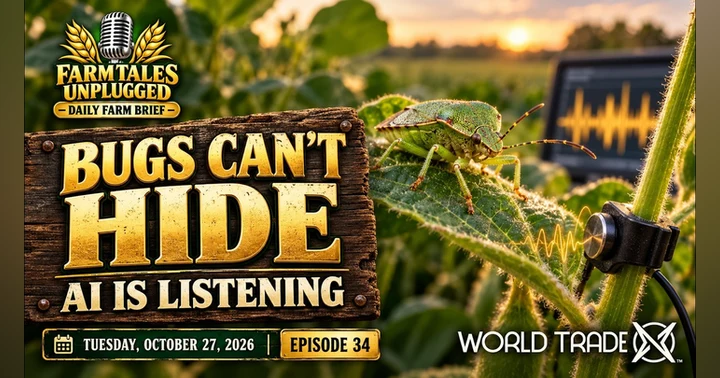
What if farmers could find crop pests by listening to them? Researchers are testing technology that detects insect vibrations—and uses artificial intelligence to help recognize what’s making them.
Join Rick Portanova for Farm Tales Unplugged — Daily Farm Brief, Episode 34, for Tuesday, October 27, 2026.
In Farm News: We look at $573 million in proposed USDA funding, including projects in Kansas and Indiana, and why farmers should watch what actually gets built. We also cover a correction to September’s crop estimate and why reliable numbers matter when deciding whether to sell grain or keep it in storage.
High-Tech Moment: Meet the “insect eavesdropper.” Kansas State researchers are testing a system in soybeans that listens for insect vibrations, with AI helping identify patterns that could improve pest monitoring.
Ohio’s wild pumpkin roll: In Chagrin Falls, pumpkins, a hill, and an unusual community tradition come together. We explore its nearly 60-year history—and the cleanup that follows.
The Old Farmer’s Almanac: Snow can help insulate winter wheat, but it can also give hungry rabbits better access to young trees. We explain the practical winter-protection takeaway.
We finish with a quick grain, cattle, and dairy market report.
More episode information at farmtalesunplugged.com.
Brought to you by World TradeX — Empowering Farmers.
Like, follow, and share Farm Tales Unplugged with someone who grows our food—or helps move it.
Sponsored by World TradeX
Good morning, Farm Nation, and Hello Truck City. This is FarmTales Unplugged Daily Farm Brief for Tuesday, October 27th. I'm Rick Portanova. Give us a few minutes every day for farm news, egg technology, family farm stories, the old farmer's almanac, and we close with the markets. Today, turning dairy manure into fertilizer, a mistake in the corn numbers farmers rely on, and a device that could catch a hidden pest by listening to it eat. Plus, an Ohio town where students go sledding on smashed-up pumpkins and how snow helps protect a winter crop. So grab your coffee, fire up whatever you're driving, and let's find out what was happening while you were busy actually working. Farm news story number one. Could dairy manure become another source of the fertilizer you buy? Two proposed plants in Kansas and Indiana would turn it into liquid fertilizer. They're part of eight manufacturing projects USDA selected last Thursday for about $573 million in proposed funding. Including other investment, the plans total more than $1.3 billion. For farmers, the part to watch is what actually gets built. Most domestic production could mean more supply and more competition for your fertilizer business. But a funding announcement doesn't put fertilizer in a dealer's tank. These projects still have to become operating plants. There is a possible improvement in the future supply, not a promise cut in your next fertilizer bill. And if this kind of farm news helps you, would you give us a follow, a like, or a share? Story number two. When you're deciding whether to sell corn or store it, you want those crop numbers to be right. USDA now says some of September's were not. The mistake came from how irrigated and dry land field data was combined in Kansas and Nebraska. It also affected the National September estimate. Here's the part to keep straight. USDA says it checked October's numbers and those remain unchanged. So this is a correction to an earlier report, not a new change to October's crop forecast. Why does that matter? Those estimates help sellers judge how much corn will be available. They're part of the information behind grain marketing decisions. The National Corn Growers Association wants stronger checks before publication. USDA says it will add checks to catch this kind of mistake. And now your high-tech moment. A bug can hide inside a soybean stem, but it may have trouble hiding the sound of its next meal. Researchers are testing a device called the insect eavesdropper. Think of a tiny microphone attached to a plant. It picks up faint vibrations from insects feeding and moving, activity our ears normally miss. Emily Bick at the University of Wisconsin-Madison developed the device. A Kansas State team is testing it against pests that tunnel inside soybean stems. Normally, finding these insects can mean cutting the plant open. With this system, researchers record the vibrations, then inspect the plants to check what was actually there. They're using artificial intelligence to help recognize the patterns. It's still being tested. The goal is an earlier warning that tells farmers where to take a closer look. You'd still scout the field, but you'd know something is eating your crop before the damage becomes obvious. Imagine a town where you don't need snow to go sledding. You need a hill and hundreds of smashed pumpkins. That's the pumpkin roll in Chagrin Falls, Ohio. For nearly 60 years, students have turned Grove Hill into a slippery orange slide. Pumpkins tumble down the street, split open, and leave a layer of pulp. Then students ride down on sleds, even upside-down folding tables. The local alumni association traces it to 1967, when students from the class of 69 set out to collect 69 pumpkins. The prank became a tradition passed from one class to the next. Students keep the date secret and stash pumpkins ahead of time. They don't necessarily wait until after Halloween. Reporting describes pumpkins disappearing from porches throughout October. Police have had their hands full with it, but they've also blocked traffic so the rolling and sliding can take place. Local news reports students raise money for fines and cleanup. Nearly 60 years later, a school prank still brings people out to watch pumpkins become a sledding hill. Snow can protect your winter wheat and help a rabbit reach higher up on your fruit trees. From the old farmer's almanac, here's what to watch. A wire mesh guard helps, but remember, snow gives rabbits a boost. A guard that worked in October may be too short above a January snow drift. Keep the bottom secure, leave room around the trunk, and check again after heavy snow. Now here's the other side of that snowbank. It can actually help keep a crop warmer. The almanac explains that snow traps air, creating insulation between the soil and the bitter cold above it. For winter wheat, that can help protect the growing point near the soil surface. University of Minnesota Extension says about three inches of snow provides useful protection through most Minnesota winters. And those stalks left standing after harvest, they can catch snow before the wind carries it away. When that snow melts, it can also help replenish soil moisture. So a snow-covered field isn't necessarily taking a beating. Underneath that winter crop may be better protected than the one on bare ground. Here's your market watch. Here's Monday's market snapshot with delayed quotes checked around 11.25 a.m. Pacific. Local cash bids will differ. December corn, 455 per bushel, down one cent. January soybeans, 1252 and a half per bushel, down 16 cents. December Chicago wheat, 615 and three quarters per bushel, down 9.25. December live cattle, 231.20 per 100 pounds, up about 8 cents. January feeder cattle, 346 per 100 pounds, up 65 cents. And November Class 3 milk was trading at 1795 per 100 pounds.com. And there you have it. That's your FarmTales Unplugged daily farm brief for Tuesday, October 27th. Brought to you by World TradeX, empowering farmers. The future of food starts with the people who grow it and depends on the people who move it. I'm Rick Cortanova, and I'll see you Wednesday morning.