YouTube

 Apple Podcasts

 Spotify

 iHeartRadio

 Amazon Music

 Audible
Weekend Farm Shockers: 800K Tons of Soybeans, Japan’s Corn Buy & Farm Tech | Daily Farm Brief

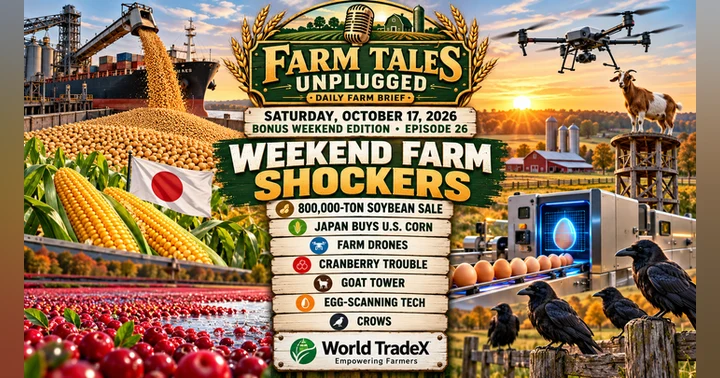
BONUS WEEKEND EDITION | Saturday, October 17, 2026 | Episode 26 An 800,000-metric-ton soybean purchase, fresh corn-buying news from Japan, and some remarkable surprises from American farm country! What do these major agricultural purchases mean for American farmers? Rick Portanova breaks down the latest export news and what it could mean for the markets. But that's just the beginning! This weekend, we're exploring farm drones, cranberry trouble, and fascinating new egg-scanning technology tha...
BONUS WEEKEND EDITION | Saturday, October 17, 2026 | Episode 26
An 800,000-metric-ton soybean purchase, fresh corn-buying news from Japan, and some remarkable surprises from American farm country!
What do these major agricultural purchases mean for American farmers? Rick Portanova breaks down the latest export news and what it could mean for the markets.
But that's just the beginning!
This weekend, we're exploring farm drones, cranberry trouble, and fascinating new egg-scanning technology that could change how eggs are inspected.
Then things get a little unusual. We're visiting a tower built for goats, discovering the surprising intelligence of crows, and sharing a little seasonal wisdom from The Old Farmer's Almanac.
It's a special weekend edition packed with real agricultural news, remarkable technology, and the unexpected stories that make farm life so interesting.
Join Rick Portanova for another lively edition of Farm Tales Unplugged — Daily Farm Brief, where farmers, truckers, and everyone connected to agriculture have a place at the table.
Brought to you by World TradeX — Empowering Farmers.
Enjoy the show? Follow, like, and share it with someone who loves farming!
Visit farmtalesunplugged.com for the matching episode blog and more.
Sponsored by World TradeX
SPEAKER_00
Good morning, Farm Nation, and Hello Truck City. This is FarmTale's Unplugged Daily Farm Brief with a bonus edition for Saturday, October 17th. Brought to you by World TradeX, empowering farmers. I'm Rick Portanova. This weekend, China bought 800,000 metric tons of American soybeans. So why did soybean prices still fall? And now there's another big order from China plus a corn purchase from Japan. We've also got farm drones reaching places a ground sprayer can't, and a lot more farmers are using them. Then a family farm offering a $150 chance to climb into its cranberry harvest, goats with their own castle tower, and an MRI scanner that can tell what's developing inside of an egg. Plus, that crow on your fence may recognize your face, and other crows can learn who to watch for. And if you enjoy the show, give us a follow, a like, or a share. That would be fantastic. So grab your coffee, fire up whatever you're driving, and let's find out what was happening while you were busy actually working. China has come back for more American soybeans. On Friday, USDA announced another 558,000 metric tons sold at China. That follows 800,000 tons announced Wednesday and Thursday that we covered on Friday's show. Those are sales commitments, the beans still have to ship. But here's the part that matters when you're watching the value of your crop. Even with those earlier Chinese orders, November soybean futures finished Thursday down 14.25 cents. The closing price was $12.63 a bushel, so the buying did not prevent a lower close. Market reports pointed to two competing pressures: freshly harvested beans coming into the system and a disappointing report on domestic soybean processing. The September processing total came in below expectations at a 13-month low. Export orders help create a home for the crop, but the market is also weighing how much grain is available and how quickly other buyers are using it. For growers, a good export headline does not automatically turn into a better bid at the elevator. On Friday, USDA also announced a sale of 127,000 metric tons of American corn to Japan for delivery during the current marketing year. And there was another demand signal for corn. American ethanol production rose about 1% in the latest weekly report. The useful picture heading into the weekend is more export business, stronger weekly ethanol output, and soybean prices that were still under pressure at Thursday's close. A wet field can stop a sprayer. A drone gives a farmer another way in. And the latest figures show how quickly that option has grown. In an analysis published Thursday, the American Farm Bureau reported that drones treated about 16.4 million acres in the United States last year. Three years earlier, that figure was 3.7 million. That is more than four times as much treated acreage. The biggest advantages can show up in awkward places, wet grounds, steep slopes, small fields with odd corners. A drone can reach those areas without driving heavy equipment through the crop. Farm Bureau also points to opportunities for rural businesses that provide spraying, scouting, or cover crop seeding. The work still takes training, the right equipment, and careful application, but this is already happening on American farms. For a grower with a field that needs attention and ground that won't carry a rig, having another option can make a real difference. Some farms sell you fruit. At Benson's Pond, you can also buy a chance to step right into the harvest. The Gilmore family runs this third-generation cranberry farm in Middleboro, Massachusetts. Its two-hour berry bog adventure is listed at $150 per person. Visitors put on waiters, walk into a flooded cranberry bog, and stand among the floating red berries. They learn how the harvest works from the people who grow the crop. The farm has sessions on its calendar for this Saturday and Sunday, October 17th and 18th. Picture that scene: a sea of red berries, the fall landscape around you, and a farmer explaining how the crop gets from the bog to your table. The Gilmores are members of the Ocean Spray Cooperative, and growing cranberries remains part of the business. They've also opened the farm to tours, educational visits, and special events. It gives people a close look at something they've probably only seen in a commercial, and it gives a working farm another way to earn from the harvest. Most goats would be happy with a rock to climb. Dave and Marcia Johnson gave theirs a tower. On their farm in central Illinois stands a brick structure 31 feet tall. It has a copper roof, small compartments inside, and a winding staircase around the outside. 276 steps. The Johnsons got the idea after seeing a goat tower in a magazine. Their version used about 5,000 bricks. Picture a narrow castle tower standing in farm country. Then picture a goat working its way around the outside and looking out from one of the openings. This has been a local curiosity for years. The goats get places to climb and explore. The people get something they are unlikely to forget. And that is the whole charm of it. A farm couple saw an unusual idea, built it, and gave their animals one remarkable playground. Hi Tech Time! An MRI scanner can look inside a human body. Now that same technology is looking inside chicken eggs before they hatch. A company called Orbum has developed a system that combines magnetic imaging with artificial intelligence. The scanner gathers information from inside the egg. The computer uses it to identify whether the developing chick is male or female. The shell stays intact. The company says its system can make that determination by about day 12 of incubation. Here's why hatcheries care. Egg laying operations need hens. Male chicks from egg laying breeds don't produce eggs, and they aren't the birds normally raised for meat. Sorting eggs before hatch offers an alternative to hatching those males and then calling them. This technology is already commercially available. Cost, accuracy, and the ability to keep up with a busy hatchery all matter. But think about what this machine is doing. An egg travels through a scanner. Software determines what's developing inside. The hatchery can sort it before a chick ever breaks through the shell. Now let's open the old farmer's almanac. That crow sitting on the fence may recognize you. And if it learns that a particular person means trouble, other crows can learn that too. For our almanac visit, let's take a closer look at a bird farmers have been trying to outsmart for generations. The old farmer's almanac points out how intelligent crows are. Researchers at the University of Washington put that intelligence to a remarkable test. They wore a particular mask while catching, banding, and releasing wild crows. Later, when someone walked through the area wearing that mask, the birds sounded the alarm. They remembered the face associated with being caught, and the response spread. Other crows that had never been captured learned to react to it. Young birds learned from their parents. The researchers followed that spread of knowledge over several years. So there's a lot more happening in a flock of crows than a lot of noise. They're watching, remembering, and learning from one another. And here's the practical part for anyone putting a scarecrow in a garden. Crows can learn that an object which never moves presents no real threat. Wildlife specialists recommend changing frightening devices and their positions instead of relying on one permanent setup. October is full of straw hats, stuffed shirts, and scarecrows, but the real bird on the fence is paying attention. You may be watching the crow. There's a fair chance the crow is studying you too. This weekend, China added another soybean order, but we explained why the earlier purchases didn't prevent Thursday's price drop. Japan ordered American corn, and farm drones are covering more American acres. We visited a family turning cranberry harvest into an experienced people pay to join, and an Illinois farm with a tower built for goats. Then an MRI scanner for eggs and crows that recognize faces and learn from each other. And if you'd like more information about any of the topics we covered, there's a matching blog for every episode we release. You'll find it on our website, farmtailsunplugged.com. To farm nation, have a safe and productive weekend. To Truck City, keep the shiny side up and the rubber side down. The future of food starts with the people who grow it and depends on the people who move it. And there you have it. That's your FarmTales Unplugged Daily Farm Brief bonus weekend edition for Saturday, October 17th. Brought to you by World TradeX empowering farmers. I'm Rick Portanova, and I'll see you Monday morning.