YouTube

 Apple Podcasts

 Spotify

 iHeartRadio

 Amazon Music

 Audible
Forgotten Seeds, Seven-Headed Wheat & a Hidden Beehive Threat, Opening Pine Cones
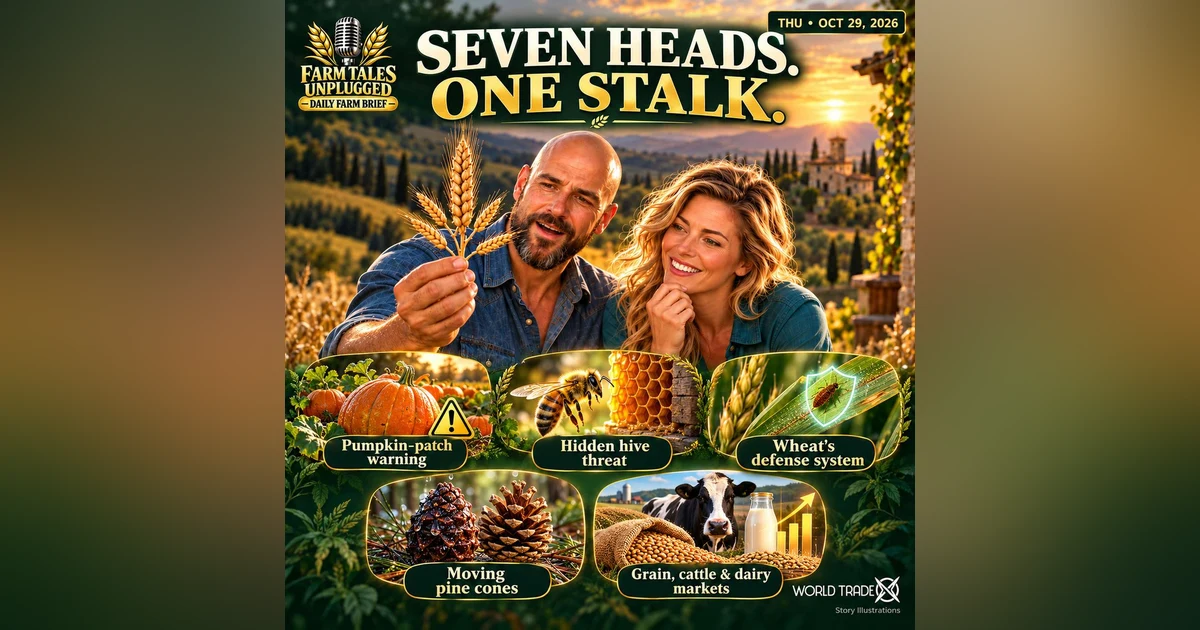

A bag of forgotten seed nearly became farmyard waste. Instead, it grew into a remarkable old-grain revival—with wheat reaching about six feet tall and a long central grain head surrounded by six smaller branches.
Join Rick Portanova for Farm Tales Unplugged — Daily Farm Brief for Thursday, October 29, 2026, brought to you by World TradeX — Empowering Farmers.
The Family Farm Story follows Claudio Grossi near Parma, Italy. A recent Smithsonian feature revisits his early-1990s attic discovery, the seeds he doubted would grow, the bread-making challenges that followed, and a later partnership with a local mill. The unusual wheat brought opportunity, but its height also left it vulnerable to falling in bad weather.
First, Farm News covers a California health investigation. San Luis Obispo County officials confirmed five E. coli infections and are investigating a possible connection to Brookshire Farms visits between October 16 and 26. The farm is cooperating and voluntarily closed. The source has not been confirmed.
We also look inside the honeybee nursery, where Tropilaelaps mites threaten developing bees. Researchers are studying this parasite overseas and working to keep it from becoming established in U.S. colonies—a concern that reaches beyond honey to the crops that depend on pollination.
In the High-Tech Moment, wheat gives us a different kind of alarm system. Scientists have identified how a resistance gene helps the plant recognize a Hessian fly larva through a signal in its saliva. The finding gives breeders a clearer target, with further development ahead.
Then a longer Old Farmer’s Almanac segment explores a fallen pine cone that still moves without living cells. See why its scales close when wet and reopen when dry, and try a simple porch-table experiment. Market Watch rounds out the show with Thursday’s grain and cattle settlements, plus a delayed November Class III milk quote.
Find the matching story background at farmtalesunplugged.com. Follow the show, share it with someone in Farm Nation or Truck City, and leave a review if it earns a place in your morning.Convert to PDF
Sponsored by World TradeX
An Italian farmer tossed some forgotten seeds onto a manure pile. Up came six-foot wheat with seven grain heads on one stock. We'll get to what he did with it. Good morning, Farm Nation, and hello, Truck City. This is FarmTale's unplugged daily farm brief for Thursday, October 29th. I'm Rick Bortonova. First, a pumpkin patch warning and a threat to our bees. Then, that remarkable grain, a plant's hidden alarm system, a pine cone that moves without living cells, and the markets. So grab your coffee, fire up whatever you're driving, and let's find out what was happening while you were busy actually working. With Halloween coming Saturday, here's something to know before heading out to the pumpkin patch. Health officials in San Luis Obispo, California have confirmed five cases of E. coli. They're investigating a possible connection to Berkshire Farms. They're looking at visits between October 16th and the 26th. The farm is cooperating and is voluntarily closed while officials investigate. Now, the source hasn't been confirmed. Officials are still trying to find out whether these cases are connected and how people got sick. If you visited during those dates and developed symptoms, the county says to contact a health care provider. Bloody diarrhea or severe stomach pain needs prompt medical attention. And if you find this show helpful, would you please give us a follow, a like, or a share? Our next story takes us inside a beehive where a tiny pest can cause a lot of trouble. It's commonly called a tropy mite. National Geographic reported this week on scientists working to get ahead of the threat. These mites attack young bees while they're still developing inside the honeycomb. The mites reproduce quickly. As their numbers grow, they damage more young bees and weaken the colony. According to USDA's monitoring information, they haven't become established in U.S. bee populations. Researchers want to keep it that way. One of those researchers is University of Colorado scientist Sammy Ramsey. He's studying the mites overseas, where they're already causing problems. And this matters to more than beekeepers. Orchards and other crops depend on healthy bees for pollination. When a colony loses bees, growers lose some of the workers they count on. Now back to that bag of forgotten seed. A new Smithsonian story introduces us to Claudio Grossi, a farmer near Parma, Italy. In the early 1990s, he was cleaning his attic when he found some old seeds. He believed they belonged to his great-grandfather. They looked worn out, he didn't think they'd grow, so he dumped them onto a manure pile. And they sprouted. Some of the wheat grew about six feet tall, and instead of an ordinary grain head, it had a long head in the middle with six smaller ones around it. Grossi saved the grain and tried making bread. He liked the flavor. Getting the dough to rise was another matter. So he worked with a baker and he kept experimenting. Eventually, a local milling company partnered with him to use the old grains in its flour business. There were challenges in the field, too. That tall wheat could get knocked over in bad weather. But think about where this started. A bag of seed he nearly threw away. It became a crop he could grow, a product he could sell, and a piece of his family farming history he could keep alive. Time for the high-tech moment. An insect takes a bite out of wheat plant, and its own saliva gives it away. USDA scientists and their university partners have figured out how a wheat resistance gene helps the plant recognize the Hessian fly. The trouble starts when the fly is still a larva, a young insect feeding near the base of the wheat leaves. In resistant wheat, a protein recognizes something in that insect's saliva. That sounds the alarm. The plant thickens its cell walls around the feeding spot. It also makes compounds that can slow down or kill the pest. So the insect starts feeding and triggers the plant's defenses. Breeders have known about this resistance for decades. What's new is that scientists have found the exact gene and worked out how it functions. That should make it easier for breeders to find that protection and bring it into wheat varieties farmers want to grow. There's more work ahead, but now they know much more about what makes that defense work. Let's open the old farmer's almanac. A pine cone that still moves. Here's something to try with a pine cone you'll find outside. Its cells are dead, but the cone can still open and close. No muscles, no nerves, just water. The old farmer's almanac points to pine cones as a clue to the moisture in the air. When it's dry, the scales open. When it's damp, they close. That happens because the layers inside each woody scale absorb water differently. One layer swells more than another and the scale bends. That little movement helps the tree. When the scales open in dry weather, seeds can come out and the wind has a better chance of carrying them away. Try this on your porch. Put an open pine cone in a jar of water. Check it over time and watch the scales close. Then take it out and let it dry. They'll open again. It won't replace your weather forecast, but it's a pretty good reminder that even a fallen pine cone still has a job to do. Market Watch. Here's Thursday's market snapshot as of 12.11 p.m. Pacific. Wheat finished higher, corn, soybeans, and cattle slipped. December corn settled at 4.51 and a quarter a bushel, down half a cent. January soybeans finished at 12.34 and three-quarters a bushel, down three and a quarter cents. December Chicago wheat closed at 6.03 and 3 quarters a bushel, up 4.3 quarter cents. December live cattle settled at 226.30 per 100weight. January feeder cattle finished at 341.95 per 100weight. For dairy, the latest available November Class 3 milk quote was $17.90 per 100weight, down 41 cents. That milk price is a delayed trading quote, not a final settlement. And remember, these are futures prices, not your local cash bid or milk check. And if you'd like more information about any of the topics we covered, there's a matching blog for every episode we release. You'll find it on our website, farmtailsunplugged.com. And there you have it. That's your FarmTales Unplugged daily farm brief for Thursday, October 29th. Brought to you by World Trade X empowering farmers. I'm Rick Portanova, and I'll see you Friday morning.