YouTube

 Apple Podcasts

 Spotify

 iHeartRadio

 Amazon Music

 Audible
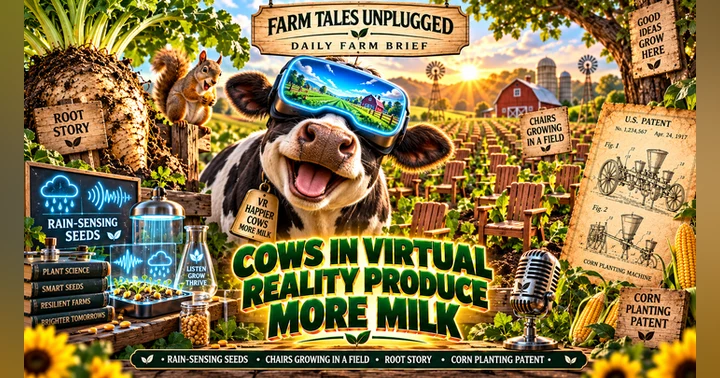
Cows in Virtual Reality Produce More Milk? Plus Trees That Grow Chairs! | Daily Farm Brief

Put a virtual-reality headset on a dairy cow, grow a chair instead of building one, and play the sound of rain for a batch of seeds. Welcome to the wonderfully strange side of farming.
Join Rick Portanova on Farm Tales Unplugged — Daily Farm Brief for an episode packed with unexpected discoveries, unusual experiments, and stories worth sharing.
Can a virtual green pasture help a cow produce more milk? We explore dairy cows wearing VR goggles and the idea behind giving cattle a different view of their surroundings. Then we head to an extraordinary orchard where living trees are shaped into chairs as they grow. Forget the lumberyard—this furniture starts in the field.
There’s plenty happening beneath the surface, too. Our corn-root story explores microbes working like tiny fertilizer factories, while a laboratory experiment asks whether rice seeds respond to the sound of rain. No ears, no weather app—just a surprising question about how plants sense their environment.
Plus: a giant pumpkin, an inventive piece of farming history, and squirrels with a few tricks up their sleeves. We revisit Henry Blair’s corn-planter patent, then turn to the Old Farmer’s Almanac for the sneaky business of squirrels and their food-hiding tactics.
From virtual pastures to living furniture, this is agriculture with a serious curiosity streak.
Hosted by Rick Portanova, for Farm Nation, Truck City, and everyone who enjoys a good story from beyond the barn door.
Follow the show and share this episode with someone who keeps us fed—or keeps it moving.
Brought to you by World TradeX — Empowering Farmers.
For more info on our covered topics visit our matching blog on our website www.farmtalesunplugged.com
Sponsored by World TradeX
Good morning, Farm Nation in Hello Truck City. This is FarmTales unplugged daily farm brief for Wednesday, October 14th. Brought to you by World TradeX empowering farmers. I'm Rick Portonova. Today, could tiny factories on corn roots help cut fertilizer bills? Bear is joining the effort. Then a giant pumpkin, chairs growing in an orchard, and the markets. Plus, cows in virtual reality, seeds that sense rain, a corn planter pioneer, and a squirrel's fake hiding place. And if you enjoy our show, give us a follow, a like, or a share. That would be fantastic. So grab your coffee, fire up whatever you're driving, and let's find out what was happening while you were busy actually working. First up, our lead news story. Imagine putting a tiny fertilizer factory on the roots of your corn. Switch engineers tiny organisms called microbes. First, they settle on plant roots. Then a genetic switch turns on production of nitrogen the plants can use. Think of getting the factory built before starting the production line. In controlled grow room tests, Switch says its microbes produce five times as much nitrogen as comparison microbes that were making it from the start. Field trials are underway across the Midwest. Fair brings experience in testing and developing agricultural products. The goal is to reduce the need for manufactured nitrogen fertilizer. Reliable results and savings on working farms still have to be demonstrated. But that's the possibility worth watching. Growing part of your fertilizer right where the crop needs it. Now imagine one pumpkin that weighs more than a ton and a half. On Saturday at Freerick's Farm, Rhode Island, Ron Wallace's pumpkin weighed 3,156 pounds. Official Guinness confirmation of a world record was still pending as of Monday. Wallace told the Associated Press that other contests offered potential prizes, reaching $75,000. He chose his local competition instead and took home $3,500. He wanted his hometown there when the number hit the scale. And from one seed, it ended up weighing more than some cars. Now, picture an orchard full of chairs, some growing upside down. In Derbyshire, England, Gavin and Alice Monroe run full-grown. They train living trees into furniture. Young branches grow around frames. The couple grafts them together where the chair needs to connect, then lets the wood thicken. The chair takes shape while the roots are still in the ground. Gavin spent part of his childhood having operations to straighten his spine. Years later, he found himself shaping and grafting living wood. A chair can take six to nine years to grow, followed by another year of drying. Then comes the smoothing and polishing. For these two, harvest means carrying a chair out of the orchard. A quick market check. At Monday's close, corn and Chicago wheat edged higher. Soybeans slipped about four cents. And Northeast Nebraska farmer Michael Stanick told Brownfield he's raising his best soybeans ever from the mid-70s to more than 80 bushels an acre. That's his farm report and welcome news from the combine. Here's a farm story that could fit in two categories: a high-tech moment combined with you don't hear that every day. A farmer put virtual reality goggles on his cows and said they gave him more milk. Back in 2022, Isaac Kokik was trying to manage rising feed costs on his farm in Askaray, Turkey. His family had farmed for three generations. He was ready to try something different. He already played classical music for the cattle. Then he fitted two cows with headsets, showing green pastures while they stood indoors. After about 10 days, he reported roughly a gallon and a third more milk per cow per day. That was his observation from a two-cow test. It would take a proper trial to establish whether the goggles caused the increase. You can't make this stuff up. But Kokik was encouraged enough to place another order. He ordered 10 more headsets. That has to be one funny sight when you walk in that barn. I'll make sure it's on our blog graphic, which covers the show topics in much greater detail. And here's the actual high-tech moment. Can the sound of rain wake up a seed? MIT researchers found that in their experiments, it could. They put rice seeds in shallow water and created the sound and vibration of falling raindrops. The seeds sat far enough from the drops that the sound waves reached them without the drops landing on them. Across the experiments, the team tested about 8,000 seeds. Those exposed to rain sounds sprouted 30 to 40% faster than seeds kept in otherwise matching conditions. Think about that. The water was already there. The vibration made the difference. Researchers suspect those vibrations jostled tiny structures inside the seed that help it sense gravity. This was reported last April. The next question is whether that discovery could become useful on a working farm. One horse, one planter, and a farmer who believed it could save the labor of eight men. On October 14th, 1834, Maryland farmer Henry Blair received a patent for his corn planter. Pulled by a horse, it opened a row, dropped the corn, covered it, and smoothed the ground. All in one pass. He signed his patent with an X and became the second black American known to receive a U.S. patent. And as you know, we always wind down by opening the old farmer's almanac. Today, a little fall watching. Watch a squirrel bury something and you might think you spotted its winter pantry. You may have spotted an empty hole. Researchers studying eastern gray squirrels observed them covering empty spots as if they had hidden food. They did it more often when other squirrels were nearby. The researchers described it as a possible way to mislead thieves. The almanac reminds us that gray squirrels don't hibernate. Fall is their time to stock up. Unfortunately, your newly planted bulbs may become part of their shopping trip. Wire mesh can help protect those bulbs. The almanac also notes that squirrels generally avoid eating daffodil and ornamental alien bulbs. So take a minute to watch what's happening outside. That squirrel patting the ground smooth may have just stored a meal. The next squirrel that sneaks over may end up digging for nothing. There's a lot happening in a quiet October yard. We started with a new effort to make fertilizer on cornroot, then a giant pumpkin, an orchard growing chairs, and a quick market check. We visited cows in virtual reality, heard how seeds respond to rain, and met a corn planter pioneer. Finally, a squirrel hiding absolutely nothing. And if you'd like more information about any of the topics we cover on our show, there's a matching blog for every episode we release. You'll find it on our website, farmtailsunplugged.com. To farm nation, have a safe and productive day. To Truck City, keep the shiny side up. The future of food starts with the people who grow it and depends on the people who move it. And there you have it. That's your FarmTales Unplugged daily farm brief for Wednesday, October 14th. Brought to you by World TradeX, empowering farmers. I'm Rick Portanova, and I'll see you Thursday morning.