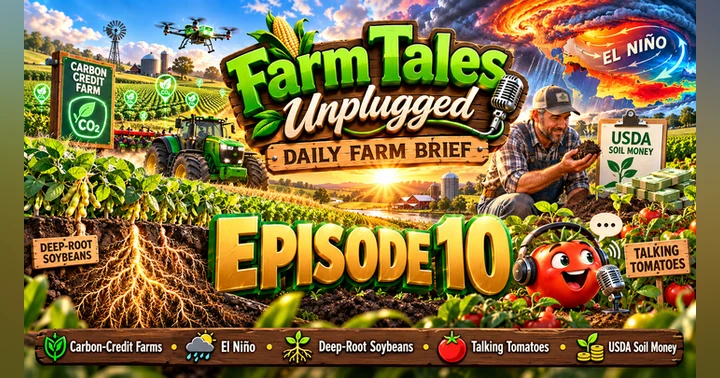
Carbon-Credit Farms, El Niño, Deep-Root Soybeans, Talking Tomatoes & USDA Soil Money | Sept. 24


On the Thursday, September 24 edition of Farm Tales Unplugged — Daily Farm Brief, Rick Portanova looks at New Zealand farmland being converted to forests for carbon credits and what that means for sheep country and rural communities.
We also look at a strengthening El Niño and what drought in Southeast Asia could mean for global rice and palm-oil supplies.
Then things get interesting: scientists are developing deeper-rooted soybeans designed to handle drought and potentially store more carbon underground, while Cornell researchers are testing Red Alert tomato plants that visibly signal when they need nitrogen.
Plus, USDA’s NRCS CEMA 216 soil-health testing program may provide financial assistance for testing soil organic carbon, respiration, aggregate stability, nitrogen, pH, texture and other soil-health indicators. USDA confirms the program and three-sample structure, while Farm Progress reports current incentive levels of roughly $520 for basic testing and $770 for advanced testing. We visit the Almanac and finish with the Farmer Joke of the Day.
Farm Tales Unplugged — where Farm Nation meets Truck City.
Brought to you by World TradeX — The Future of Food
Sponsored by World TradeX
Good morning, Farm Nation, and hello, Truck City. This is FarmTales Unplugged daily farm brief for Thursday, September 24th. I'm Rick Portanova. This morning, we've got New Zealand sheep country getting turned into forests because carbon credits may be worth more than livestock. A developing El Nino could become a global food problem if drought starts hitting major rice and palm oil regions. Scientists are building soybeans with roots designed to go deeper, survive drought, and store carbon underground. Cornell has tomato plants that can basically tell a farmer when they're hungry. And here's one farmers may actually want to write down USDA has a soil health testing program where the paperwork can come with money attached. We'll also check the almanac, go back to George Washington, and what may have been America's first crop report, and finish the day with the farmer's joke. So grab your coffee, fire up whatever you're driving, and let's get started. Quick market watch, corn harvest ahead, soybean harvest, well ahead, winter wheat planting behind, and everybody's watching the sky. Moving on. Big news story number one. When carbon credits are worth more than sheep. Here's a fascinating story coming out of New Zealand. Large areas of traditional sheep and beef country are being converted into forests. And one of the biggest reasons under New Zealand's emissions trading system, landowners can earn credits as trees grow and absorb carbon. And in some cases, planting trees can generate more financial value than raising livestock. Since 2017, roughly 3,300 square kilometers of pastoral farmland have reportedly been converted to forest. According to Reuters, that land had previously supported about 9% of New Zealand's sheep population. Now, depending on where you sit, that can look very different. Forestry investors see an economic opportunity and a way to offset carbon emissions. Farmers in rural communities see fewer families, fewer agricultural jobs, fewer kids in rural schools, and land getting harder for younger farmers to buy. So this has turned into a much bigger question than trees versus sheep. It's really about what productive farmland is for. Do you use it to grow food? Do you plant trees and generate carbon credits? Can you balance both? And somewhere in New Zealand, there's probably a sheep staring at a pine tree thinking, really? That guy took my job? Big news story number two El Nino could become a food story. This second story is one I think is worth watching because it could eventually affect food prices around the world. A strengthening El Nino is threatening parts of Southeast Asia with hotter weather, drought, and wildfire conditions. That region matters because it produces huge amounts of food and agricultural commodities, particularly rice and palm oil. Countries, including Vietnam, Thailand, Indonesia, and Malaysia, play major roles in supplying those products around the world. ER levels have already been falling in portions of the Mekong system, while rainfall has weakened in some areas. If the drought becomes severe enough, agricultural production could suffer. And once major exporters produce less, buyers start competing for whatever is available. That can move prices very quickly. A farmer in Nebraska may never see a rice field in Vietnam, but if Asian rice production gets hammered, food markets around the world can feel it. Same thing with palm oil. It ends up in food, cosmetics, and a pile of other products most people never think about. Farmers have always watched the weather. The difference today is sometimes the weather you need to worry about is on the other side of the planet. Time for the high-tech minute. Soybeans built to go deep. Scientists are working on soybean plants with deeper root systems. And the idea is pretty remarkable. Researchers at the Salk Institute are trying to develop soybeans that send their roots farther underground. That could help plants reach moisture during drought. But there's another goal. Those deeper roots may be able to store more carbon underground. Scientists have identified hundreds of genes connected with root growth and carbon storage. They're also studying something called Subarin, a carbon-rich material in roots that breaks down slowly. The theory is if crops can put more of that material deeper into the soil, some of that carbon may remain there for a very long time. Testing is underway. And before farmers adopt anything like this on a large scale, it still has to do the one thing every farmer cares about: perform. Because you can tell a farmer, we've invented a soybean that survives drought, captures carbon, and has roots that practically need a passport. And the farmer is still going to say, that's great. What's its yield? And now it's time for Weird Science! Cornell researchers are testing tomato plants that can basically tell you when they need nitrogen. Seriously, the genetically engineered plants are called red alert tomatoes. When the plant becomes nitrogen deficient, its leaves and flowers begin producing a red-purple pigment. So instead of waiting until the crop looks obviously unhealthy, the plant gives you a visible warning, literally a warning light. Except the dashboard is alive and producing tomatoes. Researchers are testing the plants under real field conditions to see how reliably they respond to changes in soil nitrogen. And eventually, similar technology could potentially be designed to detect other stresses. But don't freak out just yet. These are sentinel plants and are not intended for the food supply. Their job is to basically just stand there and complain on behalf of everybody else. Which means agriculture has officially reached the point where your tomato can file a maintenance request. Low nitrogen, need water, problem in row 14, and eventually, who the hell fertilized this place. USDA's Natural Resources Conservation Service has a soil health testing program called CEMA 216. And unlike most paperwork that shows up on a farm, this one can come with money attached. So we have finally found government paperwork where the soil sample may be worth more than the dirt stuck to your boots. If you're already thinking about soil sampling, this program is something worth asking about. From the Farmer's Almanac. According to the calendar, September 24th is considered an especially good traditional day for vine crops and other plants that produce above ground. The almanac's best days calendar also lists today as favorable for things including cutting firewood, digging holes, weaning, mowing to encourage growth, and apparently getting married. So if you've been waiting for that perfect day to plant squash, split firewood, and get married, congratulations. Your Thursday is completely shot. Personally, I'd get the firework done first. If the marriage goes sideways, at least you'll be warm. And here's the joke of the day. Farmer tells his wife, I think the tractor is starting to understand me. She says, why? He says, because every time I talk about buying another piece of equipment, it starts smoking. And that's your Farm Tales Unplugged, Daily Farm Brief for Thursday, September 24th. Today we had Sheep Country getting replaced by Carbon Credit Forest, El Nino threatening food production halfway around the world, soybeans engineered to grow deeper, tomatoes that can tell you when they're hungry, and government paperwork that may actually pay you for the soil stuck to your boots. We'd like to thank World TradeX, the future of food, for making this podcast possible. To everybody in Farm Nation and Truck City, stay safe out there. I'm Rick Portonova. We'll see you tomorrow. Music, courtesy of FMA. Credits to Philip Ravenall, JMHBM, Vlad Anikov, and Sinclips.