

 YouTube

 Apple Podcasts

 Spotify

 iHeartRadio

 Amazon Music

 Audible
Bird Flu Hits Iowa Turkeys: A Warning for Poultry Owners | Daily Farm Brief
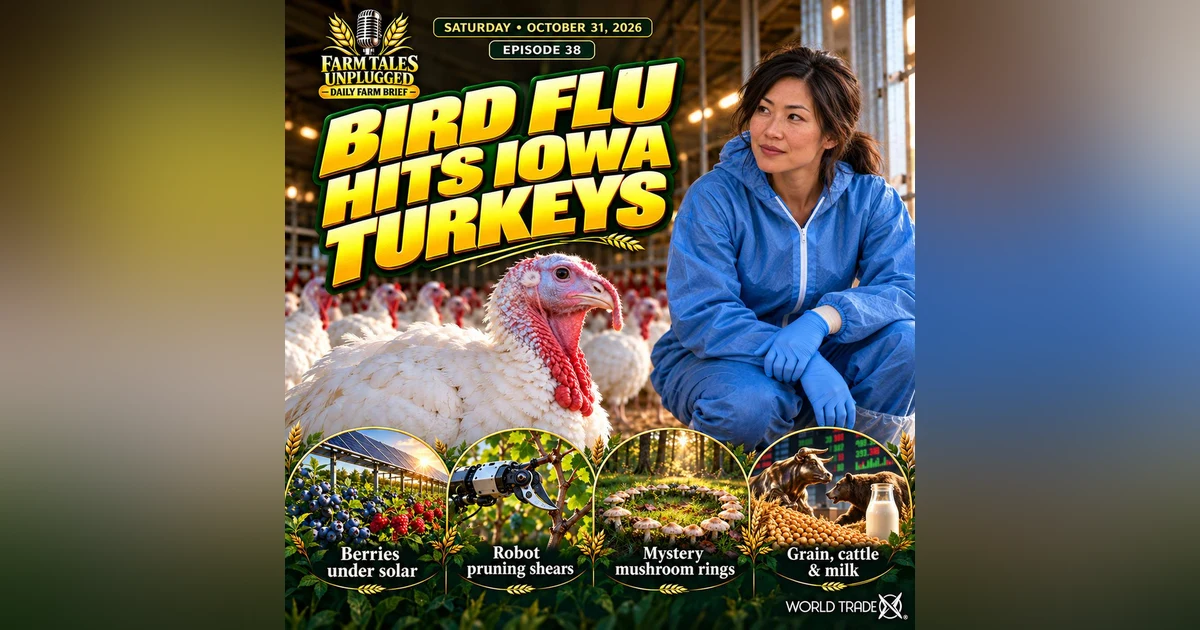

Bird flu confirmed in Iowa turkeys: state and federal officials have detected the virus in a commercial turkey flock in Sac County. Wild birds can carry it without appearing sick, while the disease can be deadly to domestic poultry. We lead with the new case, the warning signs poultry owners should watch for, and Iowa’s call for stronger disease-prevention routines.
Join Rick Portanova for Farm Tales Unplugged — Daily Farm Brief, Episode 38, for Saturday, October 31, 2026. Also: grower Iain Ward helps bring idle cranberry bogs back beneath solar panels, researchers develop robot pruning shears that need help seeing their target, and our Old Farmer’s Almanac reveals the underground secret behind mushroom fairy rings.
Market Watch includes corn, soybeans, Chicago wheat, live cattle, feeder cattle and Class III milk. Prices are a dated snapshot: Friday morning grain quotes and Thursday cattle and preliminary milk settlements, not Friday’s close.
Find the matching episode blog at farmtalesunplugged.com. Brought to you by World TradeX — Empowering Farmers.
Sponsored by World TradeX
Bird flu has hit Iowa turkeys. A commercial flock in Sack County has tested positive, and the wild birds that carry the virus can look pretty healthy. Good morning, Farm Nation and Hello Truck City. This is FarmTale's unplugged daily farm free for Saturday, October 31st, brought to you by World TradeX, empowering farmers. First, bird flu in Iowa turkeys, the warning signs and what poultry owners need to know. Then a grower bringing idle cranberry bogs back beneath solar panels, robot pruning shears, and the underground secret behind a circle of mushrooms. We'll finish with grain cattle and milk prices. And if you enjoy the show, would you give us a follow, a like, or a share? So grab your coffee, fire up whatever you're driving, and let's find out what was happening while you were busy actually working. State and federal officials announced the case Wednesday. It was Iowa's eighth detection of this virus in 2026. Here's the tricky part. Wild birds can carry it without looking sick. In chickens and turkeys, the same disease can be deadly. The state's urging commercial growers and backyard flock owners to tighten their disease prevention routines. Watch for sudden death, birds losing their appetite, or a drop in egg production. Suspected cases need an immediate call to your veterinarian. A healthy-looking wild bird is no guarantee that it isn't carrying trouble. Now to Massachusetts, where two idle cranberry bogs are growing berries again, with the help from solar panels overhead. Grower Ian Ward helped work out how to put solar equipment over two idle Massachusetts bogs without wrecking the crop underneath. The projects are in Plymouth and Kingston. The panels stand 10 feet high with more than 18 feet of clear space between rows for machinery. Even the construction mats mattered. Black mats absorbed too much heat, so crews switch to white. According to the builder, solar lease income made farming the bogs worthwhile again. The landowner receives lease payments while Ward is paid to manage the crop and also earns money from berry sales. There's still a question other growers will want answered. How do these yields compare with berries grown under full sun? That comparison hasn't been published in the announcement, but these bogs are producing food again with another income source overhead. Imagine teaching a robot to prune a fruit tree. It finds the right branch, moves in for the cut, and its own shears block the camera. That's one of the surprisingly practical problems researchers are tackling. An Oregon state research team built a prototype with two tiny distance sensors beside the cutting point. They help the machine line up the branch inside the jaws when the camera's view becomes blocked. The researchers reported promising results, but difficult lighting still cause problems. This fits an effort involving Oregon State and Washington State to teach machines which branches to remove using experienced workers, demonstrations, and explanations. That distinction matters. Reaching a branch and deciding whether it should be cut are two different jobs. This is research equipment with more testing ahead. The goal is to help with skilled orchard work that growers need done every year and increasingly struggle to staff. Let's open the old farmer's almanac. Who drew that circle? A ring of mushrooms appears in the grass, almost as if somebody planted them with a compass. For centuries, people blame dancing fairies. The old farmer's almanac tells the folklore. But the real explanation is happening underground. Those mushrooms are only the visible part of a much larger fungus. As it feeds on buried roots and other dead material, the fungus spreads outward. New mushrooms appear along the growing edge, making a circle that can widen over time. Sometimes you'll see a dark green ring of grass instead. The fungus releases nutrients as it breaks things down, giving the grass an extra feeding. Other rings can leave brown grass where dense fungal growth keeps water from soaking in. So mowing off the mushrooms won't remove the underground ring. That circle by the fence may be showing you the edge of something much bigger than you can see. Here's the latest market snapshot we could verify at time of recording. These are not Friday's closing prices. Friday's grain board stamped at 6.15 a.m. Pacific showed December corn at 449 and a quarter a bushel down two cents. January soybeans, 12.32 and a half down two and a quarter cents. December Chicago wheat, 6.03 down three-quarters cents. For cattle, Thursday's settlements were $226.30 per 100 weight for December live cattle and $341.95 for January feeders. And at our last check, Dairy, Thursday's bulletin listed November Class 3 milk at $17.93 per hundredweight. It was down 38 cents at that time. These are future prices your local cash fit and milk check will differ. And if you'd like more information about any of the topics we covered, there's a matching blog for every episode we release. You'll find it on our website, farmtailsunplugged.com. And there you have it. That's your FarmTales Unplugged daily farm brief for Saturday, October 31st, brought to you by World TradeX, empowering farmers. I'm Rick Portanova, and I'll see you Monday morning.